Developing Others - Competency
Definition: Developing Others is the ability to intentionally grow employee capability by providing stretch assignments that push people beyond their comfort zones while ensuring they have the training, tools, and coaching needed to succeed. It involves collaborating with employees to clarify career goals, map out 6 to 12‑month development plans, and create opportunities such as cross‑training, job shadowing, and mentoring to broaden skills and perspectives. Developing Others also requires offering constructive, skill‑building feedback, supporting participation in learning programs and professional networks, and creating a psychologically safe environment where employees can experiment, reflect, and learn from successes and setbacks. Finally, it includes removing barriers to growth, recognizing developmental progress, and modeling continual learning so employees see development as a shared expectation.
Employee Development
Continual Learning
Developing Others
Co-worker Development
Professional Development
Passion To Learn
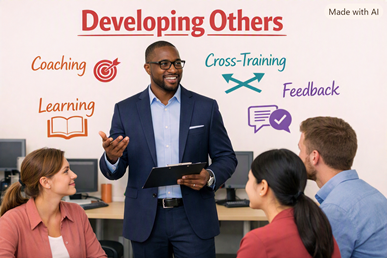
What is Developing Others?
Core Components of Developing Others
Why is Developing Others Important?
What are key aspects of Developing Others?
How can I improve my Skills in Developing Others?
What are the benefits of Developing Others?
360-Feedback questions that measure Developing Others
Core Components of Developing Others
Why is Developing Others Important?
What are key aspects of Developing Others?
How can I improve my Skills in Developing Others?
What are the benefits of Developing Others?
360-Feedback questions that measure Developing Others
360-Feedback Questionnaires Measuring Developing Others:
Survey 1 (4-point scale; Competency Comments)
Survey 2 (4-point scale; Competency Comments)
Survey 3 (5-point scale; Competency Comments)
Survey 4 (5-point scale; radio buttons)
Survey 5 (4-point scale; words)
Survey 6 (4-point scale; words)
Survey 7 (5-point scale; competency comments; N/A)
Survey 8 (3-point scale; Agree/Disagree words; N/A)
Survey 9 (3-point scale; Strength/Development; N/A)
Survey 10 (Comment boxes only)
Survey 11 (Single rating per competency)
Survey 12 (Slide-bar scale)
Survey 13 (4-point scale; numbers; floating anchors)
Survey 14 (4-point scale; N/A)
Survey 1 (4-point scale; Competency Comments)
Survey 2 (4-point scale; Competency Comments)
Survey 3 (5-point scale; Competency Comments)
Survey 4 (5-point scale; radio buttons)
Survey 5 (4-point scale; words)
Survey 6 (4-point scale; words)
Survey 7 (5-point scale; competency comments; N/A)
Survey 8 (3-point scale; Agree/Disagree words; N/A)
Survey 9 (3-point scale; Strength/Development; N/A)
Survey 10 (Comment boxes only)
Survey 11 (Single rating per competency)
Survey 12 (Slide-bar scale)
Survey 13 (4-point scale; numbers; floating anchors)
Survey 14 (4-point scale; N/A)
Self-Comments: Do you have to complete a self-assessment or performance appraisal? If so, the
self-comments here may help.
self-comments here may help.
Performance Assessments that include Developing Others:
Assessment 1 (5-point scale; IDP Comments)
Assessment 2 (3-point scale with Comments)
Assessment 3 (Manager Assessment; 360-Feedback)
Assessment 4 (3-point scale; Rating Limits)
Assessment 5 (3-point scale; Rating Limits)
Assessment 6 (5-point scale with Comments)
Assessment 7 (Comment Boxes Only; IDP)
Assessment 8 (Comment Boxes Only)
Assessment 9 (3-point scale with Letter Grade)
Assessment 10 (360-Feedback; Bonus/Merit Pay)
Assessment 11 (Core Values & Job Competencies)
Assessment 12 (4-point scale; 6 Comment Boxes)
Assessment 1 (5-point scale; IDP Comments)
Assessment 2 (3-point scale with Comments)
Assessment 3 (Manager Assessment; 360-Feedback)
Assessment 4 (3-point scale; Rating Limits)
Assessment 5 (3-point scale; Rating Limits)
Assessment 6 (5-point scale with Comments)
Assessment 7 (Comment Boxes Only; IDP)
Assessment 8 (Comment Boxes Only)
Assessment 9 (3-point scale with Letter Grade)
Assessment 10 (360-Feedback; Bonus/Merit Pay)
Assessment 11 (Core Values & Job Competencies)
Assessment 12 (4-point scale; 6 Comment Boxes)
What is Developing Others?
Developing Others is the capability to grow employee talent by providing meaningful learning experiences, structured guidance, and supportive coaching that help people build new skills and advance toward future roles. It includes assigning stretch opportunities that push employees beyond their comfort zones, offering cross-training that broadens their understanding of the business, and connecting them with mentors or subject-matter experts who accelerate their learning. Leaders reinforce development by giving constructive, skill-focused feedback, recognizing progress and accomplishments, encouraging introspection, and creating a psychologically safe learning climate where employees feel comfortable asking questions, experimenting, and learning from mistakes.
Developing Others also requires helping employees clarify their long-term career goals and translating those aspirations into personalized development plans that outline the skills to build, experiences to pursue, and milestones to achieve over the next 6 to 12 months. Leaders support these plans by recommending high-value training, certifications, and professional development opportunities that deepen expertise and strengthen capability. They conduct regular development discussions, assess growth needs, and remove barriers--such as conflicting priorities, limited resources, or excessive workloads--so employees have the time, tools, and support required to fully engage in learning.
Finally, Developing Others involves strengthening leadership capability and fostering a culture where learning is shared, visible, and valued. Leaders create opportunities for employees to lead projects, mentor others, represent the team, and practice decision-making and influence skills. They promote learning by establishing routines for knowledge sharing, encouraging participation in professional networks and industry events, and modeling continual development themselves--seeking feedback, staying current with trends, and demonstrating a commitment to growth. Through these behaviors, leaders build an environment where development is both expected and supported, enabling employees to grow with confidence and purpose.
Developing Others also requires helping employees clarify their long-term career goals and translating those aspirations into personalized development plans that outline the skills to build, experiences to pursue, and milestones to achieve over the next 6 to 12 months. Leaders support these plans by recommending high-value training, certifications, and professional development opportunities that deepen expertise and strengthen capability. They conduct regular development discussions, assess growth needs, and remove barriers--such as conflicting priorities, limited resources, or excessive workloads--so employees have the time, tools, and support required to fully engage in learning.
Finally, Developing Others involves strengthening leadership capability and fostering a culture where learning is shared, visible, and valued. Leaders create opportunities for employees to lead projects, mentor others, represent the team, and practice decision-making and influence skills. They promote learning by establishing routines for knowledge sharing, encouraging participation in professional networks and industry events, and modeling continual development themselves--seeking feedback, staying current with trends, and demonstrating a commitment to growth. Through these behaviors, leaders build an environment where development is both expected and supported, enabling employees to grow with confidence and purpose.
Core Components of Developing Others
- Stretch Assignments:focus on learning through challenging work. This dimension is about giving employees high-impact, skill-building tasks that push them beyond their comfort zones and expose them to new responsibilities.
- Career Goals:center on intentional, forward-looking development planning. This dimension is about collaborating with employees to clarify their long-term aspirations and translating those aspirations into structured 6- to 12-month development plans with defined skills, experiences, milestones, and learning activities.
- Cross-Training: broadening employees' organizational awareness and operational versatility by exposing them to different roles, departments, and workflows. It is experience-based learning that expands perspective: job shadowing, short rotations, observing specialized roles, and learning key tasks from other functions.
- Coaching: deepening expertise through targeted guidance from mentors, subject-matter experts, and experienced colleagues. It is relationship-based learning that accelerates skill growth: connecting employees with experts, facilitating mentoring relationships, coordinating learning sessions, and providing advice that helps them navigate complex responsibilities.
- Development Goals and Plans: the ongoing conversations and structured planning that guide an employee's growth. This dimension is about regularly discussing strengths, obstacles, evolving interests, and long-term aspirations, then translating those insights into individualized development plans.
- Knowledge and Skills: identifying and recommending the specific learning experiences that build the competencies outlined in those plans. This dimension is about guiding employees toward courses, certifications, workshops, training programs, and other learning opportunities that deepen expertise and strengthen performance.
- Providing Feedback: direct, skill-building guidance that helps employees understand what they are doing well, where they need to improve, and exactly how to strengthen their performance. This dimension is about giving timely, constructive, behavior-specific input that breaks down complex tasks, identifies growth opportunities, and outlines actionable steps employees can take to build targeted competencies.
- Networking: expanding employees' exposure to external ideas, experts, and professional communities that enrich their development. This dimension is about encouraging participation in conferences, workshops, associations, and industry events that broaden perspectives, deepen expertise, and connect employees with peers and thought leaders.
- Developing Leaders: preparing employees to take on greater responsibility and leadership roles by giving them opportunities to practice leading, influencing, and guiding others. This dimension is about assigning leadership-oriented tasks--such as leading projects, facilitating meetings, mentoring junior colleagues, coordinating team efforts, or representing the team in cross-department initiatives.
- Learning Climate: creating the emotional and interpersonal conditions that make learning feel safe, supported, and encouraged. This dimension is about psychological safety--ensuring employees feel comfortable asking questions, experimenting, admitting mistakes, expressing uncertainty, and trying unfamiliar tasks without fear of embarrassment or judgment.
- Developmental Progress: recognizing and reinforcing the growth employees demonstrate as they build new skills and capabilities. This dimension is about acknowledging learning milestones, celebrating improvements, highlighting skill gains, and reinforcing that effort and progress matter--not just final results.
- Removing Barriers: eliminating the practical, structural, and resource-related obstacles that prevent employees from developing. This dimension is about clearing the path for growth--adjusting workloads, securing tools and training materials, advocating for budget or resources, redistributing tasks, and streamlining processes that hinder learning.
- Promoting Learning: creating structures, routines, and opportunities that help employees learn from one another and build collective capability. This dimension is about facilitating knowledge exchange--organizing learning huddles, encouraging employees to share insights from projects or training, pairing team members to teach specialized skills, and establishing regular forums where people can pass along tips, best practices, and new techniques.
Why is Developing Others Important?
Developing Others is important because it strengthens the long-term capability, adaptability, and resilience of a team. When leaders invest in stretch assignments, cross-training, coaching, and skill-building, they create a workforce that can take on increasingly complex responsibilities and respond effectively to changing business needs. This kind of intentional development not only improves performance today but also builds a pipeline of talent that can step into future roles with confidence and competence.
It also increases engagement, motivation, and retention. Employees who receive meaningful feedback, recognition, structured development plans, and opportunities to grow feel valued and supported, which deepens their commitment to the organization. A strong learning climate--where people feel safe asking questions, experimenting, and learning from mistakes--creates a sense of belonging and psychological safety that encourages employees to stay and continue contributing at a high level.
Finally, Developing Others is essential for building a healthy, sustainable leadership culture. When leaders model continuous learning, promote knowledge sharing, encourage introspection, and remove barriers to growth, they reinforce that development is a shared expectation across the team. This creates an environment where people not only grow individually but also help each other grow, strengthening collaboration, elevating team performance, and ensuring the organization is prepared for future challenges.
It also increases engagement, motivation, and retention. Employees who receive meaningful feedback, recognition, structured development plans, and opportunities to grow feel valued and supported, which deepens their commitment to the organization. A strong learning climate--where people feel safe asking questions, experimenting, and learning from mistakes--creates a sense of belonging and psychological safety that encourages employees to stay and continue contributing at a high level.
Finally, Developing Others is essential for building a healthy, sustainable leadership culture. When leaders model continuous learning, promote knowledge sharing, encourage introspection, and remove barriers to growth, they reinforce that development is a shared expectation across the team. This creates an environment where people not only grow individually but also help each other grow, strengthening collaboration, elevating team performance, and ensuring the organization is prepared for future challenges.
What are key aspects of Developing Others?
- Stretch Assignments
- Career Goals
- Cross-Training
- Coaching
- Development Goals and Plans
- Knowledge and Skills
- Providing Feedback
- Networking
- Developing Leaders
- Learning Climate
- Developmental Progress
- Removing Barriers
- Recognition and Praise
- Encouraging Introspection
- Promoting Learning
- Role Model
- Conducts Assessments
How can I improve my Skills in Developing Others?
- Give employees meaningful stretch opportunities. Choose assignments that push people slightly beyond their comfort zones so they build new skills through real experience. Pair these challenges with coaching, tools, and regular check-ins so employees feel supported rather than overwhelmed. Over time, this builds confidence, capability, and readiness for more complex responsibilities.
- Strengthen your development planning conversations. Meet with employees regularly to discuss their career goals, emerging interests, and the skills they want to build. Work with them to create clear 6- to 12-month development plans that outline milestones, learning activities, and targeted experiences. Consistent dialogue helps employees stay focused, motivated, and aligned with future opportunities.
- Improve your coaching and feedback habits. Connect employees with mentors and subject-matter experts who can accelerate their learning and provide specialized guidance. Offer timely, constructive feedback that highlights specific behaviors and gives clear steps for improvement. When employees know exactly how to grow, they make faster and more meaningful progress.
- Create a stronger learning environment. Encourage knowledge sharing through learning huddles, project debriefs, and peer-teaching routines that help the team learn from one another. Reinforce psychological safety by responding to mistakes with support and curiosity rather than criticism. When people feel safe experimenting, asking questions, and reflecting, their development accelerates.
- Remove obstacles and celebrate progress. Adjust workloads, secure resources, and advocate for training access so employees have the time and tools needed to learn effectively. Recognize both achievements and incremental improvements to reinforce that growth is valued. This combination of support and positive reinforcement keeps development moving forward.
Improving your skills in Developing Others requires a blend of structured planning, meaningful stretch opportunities, strong coaching habits, and a supportive learning climate. When you remove barriers, celebrate progress, and model continuous learning yourself, employees feel empowered to grow and contribute at a higher level. Over time, these practices build a stronger, more capable, and more engaged team.
What are the benefits of Developing Others?
Developing Others delivers significant benefits for both employees and the organization by building long-term capability, confidence, and readiness for future challenges. When leaders invest in stretch assignments, coaching, cross-training, and structured development plans, employees gain new skills, broaden their perspective, and become more adaptable. This intentional growth strengthens overall team performance, increases operational flexibility, and ensures the organization has a strong pipeline of talent prepared to step into more complex roles as needs evolve.
It also enhances engagement, motivation, and retention. Employees who receive meaningful feedback, recognition, opportunities to learn, and support in pursuing their career goals feel valued and empowered. A strong learning climate--where people feel safe experimenting, asking questions, and reflecting on their experiences--creates a sense of belonging and trust that encourages employees to stay, contribute at a higher level, and continue growing within the organization.
It also enhances engagement, motivation, and retention. Employees who receive meaningful feedback, recognition, opportunities to learn, and support in pursuing their career goals feel valued and empowered. A strong learning climate--where people feel safe experimenting, asking questions, and reflecting on their experiences--creates a sense of belonging and trust that encourages employees to stay, contribute at a higher level, and continue growing within the organization.
What questions could you consider for including on a 360-degree feedback assessment regarding Developing Others?
360-Feedback questions that measure Developing Others
Stretch Assignments
Stretch Assignments focus on learning through challenging work. This dimension is about giving employees high-impact, skill-building tasks that push them beyond their comfort zones and expose them to new responsibilities. The emphasis is on experience-based development: assigning complex projects, providing structured support (coaching, tools, mentoring, milestone reviews), and staying actively engaged to ensure employees can navigate the challenge successfully. Stretch Assignments develop people by immersing them in demanding, real-world situations that accelerate capability growth.
- Provides stretch assignments with structured support -- pairing challenging work with guidance, check-ins, and resources.
- Gives employees challenging tasks that build new skills and provides the necessary coaching, tools, and feedback throughout the process.
- Assigns stretch projects that push employees beyond their comfort zones and pairs those assignments with regular check-ins to ensure they have the support needed to succeed.
- Develops employees by offering and encouraging them to take on new or additional responsibilities.
- Assigns tasks and responsibilities to develop skills of others.
- Gives challenging tasks to the employees.
- Designs stretch opportunities that expand an employee's capabilities and supplement them with targeted feedback and practical advice at key points in the project.
- Provides challenging tasks to subordinates.
- Helps employees grow by giving them ambitious assignments and creating a supportive framework of guidance, progress check-ins, and developmental feedback.
- Assigns high-impact tasks that require new learning and ensure employees have access to the training, tools, and coaching needed to perform successfully.
- Encourages employees to take on complex responsibilities and provide structured support (such as mentoring, resource recommendations, and milestone reviews) to help them navigate the challenge.
- Encourages others to accept projects or tasks that extend their abilities and present opportunities for development.
- Matches employees with development-focused assignments and stay actively engaged by offering guidance, answering questions, and removing obstacles as they progress.
Career Goals
Career Goals center on intentional, forward-looking development planning. This dimension is about collaborating with employees to clarify their long-term aspirations and translating those aspirations into structured 6- to 12-month development plans with defined skills, experiences, milestones, and learning activities. The emphasis is on strategic alignment: mapping out competencies to build, identifying relevant opportunities, and creating personalized development roadmaps that guide growth over time. Career Goals develop people by helping them chart a clear path toward future roles and ensuring their learning activities support that trajectory.
- Works with employees to design development plans that align their career aspirations with the skills and experiences needed for future roles.
- Partners with employees to map out targeted development plans that include new responsibilities, training opportunities, and measurable progress checkpoints.
- Assists employees in mapping out skills to build, experiences to gain, and milestones to reach over the next 6 to 12 months.
- Helps employees identify long-term career goals and translate them into a structured 6 to 12-month development roadmap with clear milestones and learning activities.
- Helps employees create career goals.
- Helps employees build structured development plans that prioritize key skills, outline growth opportunities, and establish timelines for achieving each goal.
- Creates individualized learning plans that specify which competencies to strengthen, which projects to pursue, and what success looks like at each milestone.
- Is aware of the career development goals of subordinates.
- Works with employees to create individualized development plans.
- Works with each employee to create a personalized development plan that outlines the specific skills they need to build and the experiences that will help them grow over the next year.
- Collaborates with employees to set personalized development objectives and create a clear plan that guides their learning and skill-building over the next 6 to 12 months.
Cross-Training
Cross-Training focuses on broadening employees' organizational awareness and operational versatility by exposing them to different roles, departments, and workflows. It is experience-based learning that expands perspective: job shadowing, short rotations, observing specialized roles, and learning key tasks from other functions. The goal is to help employees understand how the business operates as a whole, strengthen collaboration across teams, and build adaptable skill sets that extend beyond their primary job. In essence, Cross-Training develops employees by widening their lens and giving them hands-on exposure to diverse parts of the organization.
- Offers job shadowing or cross-training opportunities.
- Arranges job-shadowing opportunities that allow employees to observe colleagues in other roles.
- Exposes employees to other roles, departments, or processes to broaden their understanding of the organization.
- Supports employee development by giving them opportunities to observe how other teams work, helping them understand how their role connects to broader organizational goals.
- Encourages employees to spend time shadowing team members in specialized roles to broaden their perspective and build new skills.
- Helps employees expand their knowledge by coordinating short rotations in other areas of the organization where they can learn new processes and workflows.
- Strengthens team capability by creating structured job-shadowing experiences that allow employees to learn from experts in other functions and apply those insights to their own work.
- Exposes employees to different parts of the business by offering cross-training assignments that deepen their operational awareness and versatility.
- Provides cross-training experiences so employees can learn key tasks from other departments and strengthen their overall understanding of how the business operates.
Coaching
Coaching centers on deepening expertise through targeted guidance from mentors, subject-matter experts, and experienced colleagues. It is relationship-based learning that accelerates skill growth: connecting employees with experts, facilitating mentoring relationships, coordinating learning sessions, and providing advice that helps them navigate complex responsibilities. The goal is to build specialized capability, strengthen decision-making, and offer personalized insight that supports mastery of advanced skills. In essence, Coaching develops employees by giving them access to people who can elevate their thinking, refine their abilities, and support their long-term growth.
- Connects employees with mentors and subject-matter experts who can provide guidance, share insights, and help them build deeper expertise.
- Facilitates access to mentors and subject-matter experts.
- Helps employees expand their knowledge by arranging mentoring relationships with experts who can accelerate their learning.
- Helps to coach other employees.
- Facilitates access to knowledgeable mentors who provide targeted advice and are able to help employees navigate complex responsibilities.
- Encourages employees to seek guidance from subject-matter experts and make those connections easier by coordinating introductions and learning sessions.
- Pairs employees with experienced colleagues who can offer new perspectives, answer questions, and support their development in specialized areas.
- Introduces employees to internal and external specialists who can coach them on advanced skills and industry best practices.
- Strengthens employee development by linking them with mentors who offer real-world experience, strategic insight, and ongoing support.
- Provides advice and suggestions to others.
- Connects employees with people who can accelerate their learning and offer their perspective.
Development Goals and Plans
Development Goals and Plans focuses on the ongoing conversations and structured planning that guide an employee's growth. This dimension is about regularly discussing strengths, obstacles, evolving interests, and long-term aspirations, then translating those insights into individualized development plans. It emphasizes reflection, dialogue, and alignment--holding consistent check-ins, refining goals as circumstances change, and ensuring employees have clarity about what they are working toward. In essence, Development Goals and Plans is the strategic, conversational side of development: helping employees define where they want to go and shaping a roadmap to get there.
- Holds ongoing development discussions that help employees reflect on their progress, adjust their goals, and explore emerging career aspirations.
- Frequently discusses career goals with employees.
- Engages employees in thoughtful conversations about their strengths, areas for improvement, and the experiences that will help them advance.
- Schedules regular development conversations with employees to review their progress, discuss challenges, and identify new opportunities for growth.
- Regularly discusses progress, obstacles, new interests, and evolving career aspirations.
- Regularly checks in with employees about their development plans, offering guidance and helping them refine their goals as their interests evolve.
- Creates space for employees to share what they're learning, what they want to pursue next, and what support they need to continue growing.
- Maintains consistent development dialogues that focus on progress, barriers, new skill interests, and long-term career direction.
- Meets with employees consistently to talk through their learning goals, career interests, and any obstacles that may be slowing their development.
- Helps subordinates in building Individual Development Plans.
- Holds regular development conversations with employees.
Knowledge and Skills
Knowledge and Skills centers on identifying and recommending the specific learning experiences that build the competencies outlined in those plans. This dimension is about guiding employees toward courses, certifications, workshops, training programs, and other learning opportunities that deepen expertise and strengthen performance. It emphasizes action and skill acquisition--staying informed about relevant training options, recommending high-value programs, and helping employees choose learning paths that align with both their goals and organizational needs. In essence, Knowledge and Skills is the practical, resource-focused side of development: helping employees build the capabilities required to advance along their chosen path.
- Recommends courses and certifications that match each employee's development goals.
- Guides employees toward learning opportunities such as workshops, online courses, or certifications.
- Helps employees choose learning programs that offer the greatest impact.
- Recommends relevant courses, certifications, or learning programs.
- Suggests targeted development programs that build critical competencies and prepare employees for upcoming responsibilities or advancement opportunities.
- Helps employees identify high-value training aligned with their goals and the organization's needs.
- Encourages employees to pursue certifications and structured learning paths that deepen expertise and contribute to stronger team and business outcomes.
- Stays informed about relevant training options and proactively share recommendations that support employees' long-term skill development.
- Helps employees identify high-value training programs that strengthen their capabilities and align with both their career aspirations and departmental priorities.
- Creates opportunities for professional development.
- Facilitates employee training when implementing new programs or systems.
- Enhances the knowledge and skills of others.
Providing Feedback
Providing Feedback focuses on direct, skill-building guidance that helps employees understand what they are doing well, where they need to improve, and exactly how to strengthen their performance. This dimension is about giving timely, constructive, behavior-specific input that breaks down complex tasks, identifies growth opportunities, and outlines actionable steps employees can take to build targeted competencies. It emphasizes clarity, coaching, and continuous improvement--helping employees translate feedback into meaningful changes in their work habits, confidence, and capabilities. In essence, Providing Feedback develops employees by offering precise direction that accelerates skill growth.
- Provides actionable guidance that helps employees understand exactly what to improve.
- Gives employees constructive feedback that highlights specific behaviors and offers clear steps they can take to strengthen their skills.
- Provides constructive feedback to others.
- Delivers developmental feedback focused on building targeted competencies.
- Makes sure that employees are aware of how they perform in their job.
- Gives feedback that identifies growth opportunities and outlines specific actions employees can take to develop those skills.
- Is open to receiving feedback.
- Provides clear, constructive input that helps employees translate feedback into meaningful changes in employee work habits and capabilities.
- Provides constructive, actionable feedback.
- Offers feedback that breaks down complex tasks into practical suggestions employees can use to improve their performance.
- Gives timely, skill-focused feedback that helps employees correct issues, build confidence, and make measurable progress.
- Provides developmental feedback that helps employees grow specific skills.
Networking
Networking centers on expanding employees' exposure to external ideas, experts, and professional communities that enrich their development. This dimension is about encouraging participation in conferences, workshops, associations, and industry events that broaden perspectives, deepen expertise, and connect employees with peers and thought leaders. It emphasizes external learning, professional visibility, and staying current with trends--helping employees gain insights they cannot access solely within their immediate team or organization. In essence, Networking develops employees by opening doors to new knowledge sources, diverse viewpoints, and relationships that support long-term career growth.
- Encourages employees to attend external networks, conferences, or workshops.
- Recommends industry events that align with employees' development goals and helps them stay current with changes in the field.
- Provides opportunities for employees to engage with external experts and professional communities that enhance learning and career growth.
- Supports employee participation in professional associations or industry events.
- Supports employee participation in external workshops, networking events, and association programs that build relevant skills and insights.
- Encourages employees to join professional groups and attend events that broaden their perspectives and connect them with peers across the industry.
- Supports employees in attending conferences, workshops, and seminars that expose them to new ideas, best practices, and emerging trends.
- Helps employees identify high-value conferences and association activities that deepen their understanding of industry challenges and innovations.
- Encourages employees to participate in professional associations and industry events that expand their knowledge and strengthen their professional networks.
Developing Leaders
Developing Leaders focuses on preparing employees to take on greater responsibility and leadership roles by giving them opportunities to practice leading, influencing, and guiding others. This dimension is about assigning leadership-oriented tasks--such as leading projects, facilitating meetings, mentoring junior colleagues, coordinating team efforts, or representing the team in cross-department initiatives. It emphasizes capability building through real leadership experiences, helping employees strengthen decision-making, communication, ownership, and readiness for the next level. In essence, Developing Leaders grows people by placing them in situations where they must act as leaders and learn through doing.
- Gives employees leadership opportunities by assigning them small projects where they can take ownership, make decisions, and guide the work to completion.
- Builds leadership capability by assigning employees to roles where they must influence others, manage timelines, and communicate progress effectively.
- Allows employees to represent the team in cross-department meetings or collaborative initiatives.
- Helps employees grow by asking them to mentor junior colleagues, providing guidance while allowing them to practice coaching and support skills.
- Encourages employees to develop leadership skills by having them facilitate team meetings and lead discussions on key topics.
- Promotes employees to higher positions.
- Tries to ensure employees are ready to move to the next level.
- Strengthens employee development by giving them the responsibility for coordinating project tasks and for guiding their teammates toward shared goals.
- Creates leadership opportunities for employees.
- Assigns leadership roles such as leading a small project, facilitating a meeting, or mentoring a junior colleague.
- Gives employees leadership opportunities.
Learning Climate
Learning Climate focuses on creating the emotional and interpersonal conditions that make learning feel safe, supported, and encouraged. This dimension is about psychological safety--ensuring employees feel comfortable asking questions, experimenting, admitting mistakes, expressing uncertainty, and trying unfamiliar tasks without fear of embarrassment or judgment. It emphasizes encouragement, openness, and supportive reactions to errors, reinforcing that learning is valued more than perfection. In essence, Learning Climate develops employees by shaping a team environment where curiosity, risk-taking, and honest reflection are welcomed and protected.
- Creates an environment where employees feel comfortable asking questions and exploring new ideas without worrying about being judged.
- Creates a psychologically safe environment for learning.
- Encourages employees to ask questions, experiment, and learn from mistakes without fear of embarrassment.
- Creates a supportive atmosphere where employees can test new methods, reflect on outcomes, and adjust their approach without fear of embarrassment.
- Ensures employees feel respected and encouraged when they take on unfamiliar tasks.
- Encourages experimentation by reassuring employees that mistakes are part of learning and will be treated as opportunities for growth.
- Reinforces that learning is valued more than perfection.
- Fosters open dialogue where employees can express uncertainty, seek clarification, and share learning needs without hesitation.
- Models psychological safety by admitting my own mistakes and showing how I learn from them, reinforcing that growth comes from trying and improving.
- Responds to errors with support and guidance rather than criticism, helping employees to feel safe taking risks and trying new approaches.
Developmental Progress
Developmental Progress centers on recognizing and reinforcing the growth employees demonstrate as they build new skills and capabilities. This dimension is about acknowledging learning milestones, celebrating improvements, highlighting skill gains, and reinforcing that effort and progress matter--not just final results. It emphasizes motivation, confidence, and a growth mindset by calling attention to meaningful strides in problem-solving, collaboration, confidence, or other competencies. In essence, Developmental Progress develops people by making their growth visible, valued, and encouraged, helping them stay engaged and committed to continuous improvement.
- Reinforces a growth mindset by acknowledging learning milestones and developmental achievements, not just finished work.
- Makes a point to recognize incremental improvements, helping employees stay motivated as they continue building their capabilities.
- Sets performance objectives for subordinates that encourages development opportunities.
- Recognizes employees for the effort and learning they demonstrate.
- Recognizes when developmental progress is being met.
- Reminds employees that improvement is just as important as results.
- Celebrates meaningful growth (such as increased confidence, stronger problem-solving, or improved collaboration) to show that development is valued at the company.
- Acknowledges employees' developmental progress by highlighting the new skills they've built.
- Reinforces that learning, effort, and improvements matter.
- Calls attention to skill gains and learning breakthroughs so employees understand that their progress is seen and appreciated.
- Provides positive reinforcement when employees make noticeable strides in their abilities, regardless of whether the task is fully completed.
Removing Barriers
Removing Barriers focuses on eliminating the practical, structural, and resource-related obstacles that prevent employees from developing. This dimension is about clearing the path for growth--adjusting workloads, securing tools and training materials, advocating for budget or resources, redistributing tasks, and streamlining processes that hinder learning. It emphasizes access, capacity, and enablement, ensuring employees have the time, support, and resources required to pursue development opportunities. In essence, Removing Barriers develops employees by addressing the logistical and organizational constraints that limit their ability to learn and grow.
- Adjusts workloads so employees have the time and capacity to focus on building new skills.
- Removes barriers to development.
- Eliminates obstacles to learning by securing access to training materials, software, or equipment that supports employees' development goals.
- Actively removes constraints (such as conflicting priorities or excessive workloads) that prevent employees from participating in training or skill-building activities.
- Enables employees to pursue growth by adjusting workloads, providing tools, or advocating for resources.
- Ensures employees can pursue growth opportunities by reallocating tasks or redistributing work when their development plans require dedicated time.
- Advocates for employees' development needs by requesting budget, resources, or organizational support that enables them to pursue meaningful learning opportunities.
- Advocates for the tools, technology, and resources employees need to fully engage in their learning and development activities.
- Helps employees overcome development challenges by providing additional support, clarifying expectations, or streamlining processes that hinder progress.
Recognition and Praise
Recognition and Praise focuses on reinforcing positive performance and motivating employees by acknowledging their accomplishments, effort, and meaningful contributions. This dimension is about celebrating achievements--big or small--through timely, specific praise that highlights what employees did well and why it mattered. It emphasizes confidence-building, motivation, and creating a positive environment where employees feel valued for their successes and progress. In essence, Recognition and Praise develops employees by making their achievements visible and appreciated, strengthening engagement and reinforcing effective behaviors.
- Makes a point to acknowledge employees when they accomplish important tasks or deliver strong results.
- Encourages both team members and associates through recognition of positive changes in behavior.
- Creates a work environment that fosters positive feedback to employees.
- Recognizes and celebrates accomplishments of others.
- Offers timely recognition when employees achieve goals, ensuring they feel appreciated for their effort and success.
- Supports the successes of other employees.
- Encourages employees through recognition of positive changes in behavior.
- Publicly acknowledges employees who reach milestones or complete significant projects to reinforce positive performance.
- Gives specific praise when employees accomplish something noteworthy, emphasizing what they did well and why it mattered.
- Celebrates employee accomplishments (big or small) to reinforce the idea that their contributions matter.
- Consistently recognizes employees for their achievements to help build confidence, motivation, and a sense of value within the team.
- Rewards and recognizes employees for engaging in professional development activities.
- Recognizes employees for completing challenging assignments and highlight the impact of their work on the team or organization.
- Recognizes employees when they accomplish things.
Encouraging Introspection
Encouraging Introspection centers on helping employees learn from their experiences by prompting thoughtful reflection on successes, failures, and new challenges. This dimension is about guiding employees to analyze what worked, what didn't, what they learned, and how they can apply those insights going forward. It emphasizes self-awareness, critical thinking, and continuous improvement--supporting employees in building reflective habits that deepen their understanding of their own growth. In essence, Encouraging Introspection develops employees by turning experiences into learning, helping them extract insights that shape stronger future performance.
- Helps employees build reflective habits by discussing what went well, what didn't, and what they would do differently next time.
- Encourages employees to pause after completing major tasks and consider the insights gained from both the challenges and the achievements.
- Prompts employees to think about the skills they strengthened during new experiences and how those skills can be applied going forward.
- Encourages reflective practices.
- Asks employees to analyze what they learned from mistakes or setbacks so they can turn those experiences into meaningful growth.
- Supports reflective practice by asking employees to articulate key lessons learned and how those lessons will shape their future approach.
- Encourages employees to reflect on recent successes and identify the specific actions or decisions that contributed to those positive outcomes.
- Asks employees to analyze what they learned from successes, failures, and new experiences.
- Guides employees through reflective conversations that help them connect their experiences to broader development goals.
Promoting Learning
Promoting Learning focuses on creating structures, routines, and opportunities that help employees learn from one another and build collective capability. This dimension is about facilitating knowledge exchange--organizing learning huddles, encouraging employees to share insights from projects or training, pairing team members to teach specialized skills, and establishing regular forums where people can pass along tips, best practices, and new techniques. It emphasizes team-based learning, collaboration, and building a culture where employees actively contribute to each other's growth. In essence, Promoting Learning develops employees by enabling continuous knowledge flow across the team.
- Promotes knowledge sharing by creating regular opportunities for employees to teach each other new skills, tools, and techniques.
- Encourages employees to participate in development programs.
- Encourages team members to share insights from their projects so others can learn from their experiences.
- Promotes knowledge sharing within the team.
- Supports knowledge sharing by pairing employees so they can teach each other specialized skills and broaden their understanding of team processes.
- Creates an environment where employees feel comfortable sharing expertise, helping the team build collective knowledge and improve performance.
- Encourages employees to document and share useful insights, making it easier for the entire team to benefit from individual learning.
- Establishes routines (such as learning huddles or skill-sharing sessions) where employees exchange practical tips and best practices.
- Strengthens team capability by having employees present what they've learned from training, conferences, or major assignments.
- Creates routines where employees can teach each other new skills or insights.
- Recognizes that each employee needs training and development based on their individual learning style.
Role Model
Role Model centers on demonstrating personal commitment to learning so employees see development as a shared expectation, not just a directive. This dimension is about leading by example--participating in training, staying current with industry trends, seeking feedback, embracing new challenges, and openly discussing personal learning goals and progress. It emphasizes visibility, authenticity, and modeling a growth mindset that signals learning is valued at every level. In essence, Role Model develops employees by showing them what continual learning looks like in practice and inspiring them to adopt the same mindset.
- Openly discusses their own learning goals and progress so employees can see that continual improvement is expected at every level.
- Models a growth mindset by embracing new challenges, experimenting with new approaches, and reflecting on what was learned along the way.
- Shows employees that learning is valued by seeking feedback on work and using it to strengthen skills and leadership.
- Demonstrates a commitment to development so employees could see learning as a shared expectation.
- Demonstrates continual learning by regularly updating knowledge, tools, and methods, signaling that development is a shared responsibility across the team.
- Demonstrates commitment to development by participating in training, workshops, or courses and encouraging employees to do the same.
- Stays current with industry trends and share relevant insights with the team to reinforce the importance of ongoing professional growth.
Conducts Assessments
- Assesses employees' developmental needs.
- Uses planned and unplanned visits as opportunities to train.
- Conducts regular reviews to explore development opportunities.