Trustworthy - Competency
Definition: Trustworthy managers act with integrity and principled judgment, aligning their words, values, and actions while demonstrating honesty, ethical decision-making, and respect for confidentiality. They are dependable, committed, and reliable--consistently following through on obligations, upholding high standards, and delivering competent, high-quality work that inspires confidence. They communicate openly and transparently, responding promptly to needs, sharing information that empowers others, and creating an environment where concerns are heard and addressed constructively. Through accountability, consistent role-modeling, and deliberate efforts to build trust across relationships and teams, they foster a culture where people feel safe to collaborate, take risks, and excel.
Collaboration
Trustworthy
Responsible
Client Focus
Customer Focus
Employee Relations
Engagement
Partnering/Networking
Conflict Management
Negotiation
Mediation
Teamwork
Recognition
Others
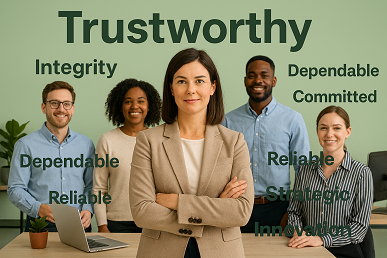
What Is Being Trustworthy?
Core Components of Trustworthiness
Why is Being Trustworthy important?
How can I improve Trustworthiness?
What are the benefits of being Trustworthy?
360-Feedback questions that measure Trustworthiness:
Core Components of Trustworthiness
Why is Being Trustworthy important?
How can I improve Trustworthiness?
What are the benefits of being Trustworthy?
360-Feedback questions that measure Trustworthiness:
Self-Comments: Do you have to complete a self-assessment or performance appraisal? If so, the
self-comments here may help.
self-comments here may help.
360-Feedback Questionnaires Measuring Trustworthiness:
Survey 1 (4-point scale; Competency Comments)
Survey 2 (4-point scale; Competency Comments)
Survey 3 (5-point scale; Competency Comments)
Survey 4 (5-point scale; radio buttons)
Survey 5 (4-point scale; words)
Survey 6 (4-point scale; words)
Survey 7 (5-point scale; competency comments; N/A)
Survey 8 (3-point scale; Agree/Disagree words; N/A)
Survey 9 (3-point scale; Strength/Development; N/A)
Survey 10 (Comment boxes only)
Survey 11 (Single rating per competency)
Survey 12 (Slide-bar scale)
Survey 13 (4-point scale; numbers; floating anchors)
Survey 14 (4-point scale; N/A)
Survey 1 (4-point scale; Competency Comments)
Survey 2 (4-point scale; Competency Comments)
Survey 3 (5-point scale; Competency Comments)
Survey 4 (5-point scale; radio buttons)
Survey 5 (4-point scale; words)
Survey 6 (4-point scale; words)
Survey 7 (5-point scale; competency comments; N/A)
Survey 8 (3-point scale; Agree/Disagree words; N/A)
Survey 9 (3-point scale; Strength/Development; N/A)
Survey 10 (Comment boxes only)
Survey 11 (Single rating per competency)
Survey 12 (Slide-bar scale)
Survey 13 (4-point scale; numbers; floating anchors)
Survey 14 (4-point scale; N/A)
Performance Assessments that include Trustworthy:
Assessment 1 (5-point scale; IDP Comments)
Assessment 2 (3-point scale with Comments)
Assessment 3 (Manager Assessment; 360-Feedback)
Assessment 4 (3-point scale; Rating Limits)
Assessment 5 (3-point scale; Rating Limits)
Assessment 6 (5-point scale with Comments)
Assessment 7 (Comment Boxes Only; IDP)
Assessment 8 (Comment Boxes Only)
Assessment 9 (3-point scale with Letter Grade)
Assessment 10 (360-Feedback; Bonus/Merit Pay)
Assessment 11 (Core Values & Job Competencies)
Assessment 12 (4-point scale; 6 Comment Boxes)
Assessment 1 (5-point scale; IDP Comments)
Assessment 2 (3-point scale with Comments)
Assessment 3 (Manager Assessment; 360-Feedback)
Assessment 4 (3-point scale; Rating Limits)
Assessment 5 (3-point scale; Rating Limits)
Assessment 6 (5-point scale with Comments)
Assessment 7 (Comment Boxes Only; IDP)
Assessment 8 (Comment Boxes Only)
Assessment 9 (3-point scale with Letter Grade)
Assessment 10 (360-Feedback; Bonus/Merit Pay)
Assessment 11 (Core Values & Job Competencies)
Assessment 12 (4-point scale; 6 Comment Boxes)
What Is Being Trustworthy?
Trustworthy individuals act with unwavering integrity, aligning their decisions and behaviors with clear values, principles, and ethical standards. They demonstrate honesty and transparency by communicating openly about intentions, limitations, challenges, and mistakes, and they use those moments to strengthen credibility rather than diminish it. Their principled judgment ensures they follow required procedures, uphold organizational interests, and handle confidential or sensitive information with discretion and sound judgment. Through consistent ethical choices and congruence between beliefs, communication, and behavior, they establish themselves as dependable stewards of trust.
They build confidence through reliability, competence, and high-quality performance, consistently delivering work that reflects care, precision, and professionalism. Trustworthy individuals can be counted on to follow through on commitments, meet expectations, and uphold rigorous performance and quality standards even when circumstances are difficult. Their responsiveness (acting swiftly and appropriately when challenges arise) signals reliability and reinforces others' confidence in their judgment. By sharing timely, meaningful information and communicating openly about decisions, context, and concerns, they empower others to act with clarity and ownership, strengthening mutual trust across teams and stakeholders.
As role models, trustworthy individuals foster a culture where accountability, transparency, and principled action are the norm. They take responsibility for outcomes, acknowledge errors promptly, and address performance gaps constructively, demonstrating that accountability applies equally to themselves and others. Their consistent behavior builds and maintains trust over time, enabling collaboration, risk-taking, and innovation. By embodying integrity, dependability, ethical judgment, and open communication, they create an environment where people feel respected, informed, and confident that commitments will be honored and decisions will be made with fairness and professionalism.
They build confidence through reliability, competence, and high-quality performance, consistently delivering work that reflects care, precision, and professionalism. Trustworthy individuals can be counted on to follow through on commitments, meet expectations, and uphold rigorous performance and quality standards even when circumstances are difficult. Their responsiveness (acting swiftly and appropriately when challenges arise) signals reliability and reinforces others' confidence in their judgment. By sharing timely, meaningful information and communicating openly about decisions, context, and concerns, they empower others to act with clarity and ownership, strengthening mutual trust across teams and stakeholders.
As role models, trustworthy individuals foster a culture where accountability, transparency, and principled action are the norm. They take responsibility for outcomes, acknowledge errors promptly, and address performance gaps constructively, demonstrating that accountability applies equally to themselves and others. Their consistent behavior builds and maintains trust over time, enabling collaboration, risk-taking, and innovation. By embodying integrity, dependability, ethical judgment, and open communication, they create an environment where people feel respected, informed, and confident that commitments will be honored and decisions will be made with fairness and professionalism.
Core Components of Trustworthiness
- Integrity: the internal alignment between a manager's values, beliefs, words, and actions. It reflects the moral and ethical foundation that guides behavior, even when no one is watching.
- Dependable: the external reliability of a manager's actions--how consistently they follow through, deliver, and meet expectations. It reflects the behavioral pattern of doing what one says they will do, honoring commitments, meeting deadlines, and producing consistent results over time.
- Committed: a manager's internal dedication to their promises, goals, and values. It emphasizes intention, ownership, and persistence. A committed manager keeps their word because they feel personally responsible for doing so--they take ownership, uphold their agreements, and persist even when the work is difficult or inconvenient.
- Reliable: a manager's external consistency--their ability to deliver high-quality results, meet expectations, and perform dependably over time. Reliability is less about internal resolve and more about observable, predictable performance.
- Principled: a manager's adherence to core values, standards, and organizational expectations, even when doing so is inconvenient or unpopular. It emphasizes a steady internal compass--fairness, honesty, impartiality, respect, and alignment with rules, procedures, and the organization's best interests.
- Ethical and Moral: a manager's active practice of ethical reasoning, responsible decision-making, and moral courage in day-to-day situations. It emphasizes recognizing ethical dilemmas, choosing the right course of action, and addressing wrongdoing promptly and responsibly.
- Confidential: a manager's ability to protect sensitive information, respect boundaries, and exercise discretion. It is about safeguarding what others share (whether personal details, organizational information, or sensitive issues) and ensuring it is not disclosed inappropriately.
- Honest: a manager's ability to communicate truthfully, transparently, and with integrity, especially when the message is difficult. It is about being candid, accurate, and forthcoming--admitting mistakes, acknowledging uncertainty, and avoiding misrepresentation.
- Transparent: a manager's willingness to reveal information, context, intentions, and reasoning--especially around decisions, constraints, sensitive issues, and organizational direction. It is fundamentally about visibility: making the "why" behind decisions clear, sharing implications, and not withholding important details.
- Open Communication: the two-way relational process of exchanging information, listening, responding, and engaging with others' needs, concerns, and perspectives. It is fundamentally about interaction: being approachable, responsive, candid, and willing to discuss challenges, setbacks, and lessons learned.
- High Standards: a manager's expectations for excellence--both for themselves and for their team emphasizing the pursuit of superior quality, rigorous performance benchmarks, and consistently exceptional outcomes. A manager strong in this area sets ambitious expectations, insists on professionalism, and ensures that every deliverable meets or exceeds established quality criteria.
- Competent: a manager's ability to perform their role effectively, demonstrating the skills, judgment, and knowledge required to meet the demands of the job emphasizing capability, accuracy, sound decision-making, and the consistent production of reliable results. A competent manager demonstrates care and precision, pays attention to detail, and makes informed decisions that inspire confidence.
- Responsive: a manager's timeliness, availability, and willingness to act quickly when others need support. It is about being present, attentive, and proactive--addressing concerns before they escalate, stepping in during high-pressure moments, and ensuring employees and customers feel heard and supported.
- Accountability: a manager's ownership of actions, decisions, and outcomes, both for themselves and for others. It emphasizes responsibility, follow-through, and integrity--acknowledging mistakes, correcting them, and ensuring commitments are met.
- Role Model: a manager's personal example--the way their own behavior embodies the standards, values, and conduct that others are expected to follow. It is about who the manager is in the eyes of others: someone whose actions consistently reinforce credibility, fairness, and integrity.
- Builds Trust: a manager's active, intentional efforts to strengthen trust across relationships, teams, and the broader work environment. It is about what the manager does to cultivate trust between people--not just through their own example, but through deliberate actions that foster openness, psychological safety, collaboration, and resilience.
Why is Being Trustworthy important?
Being trustworthy is essential in business because it forms the foundation of every productive relationship--whether with customers, employees, partners, or stakeholders. When individuals and organizations act with integrity, reliability, and transparency, they reduce uncertainty and create an environment where people feel confident making commitments, sharing information, and collaborating toward shared goals. Trustworthiness accelerates decision-making, strengthens communication, and minimizes the friction that comes from doubt or second-guessing. In competitive markets, it also becomes a differentiator: customers return to companies they believe will deliver consistently, honor their promises, and act ethically even when no one is watching.
Within organizations, trustworthiness fuels performance, accountability, and innovation. Employees are more willing to take risks, raise concerns, and contribute their best ideas when they trust that leaders will act fairly, communicate openly, and uphold high standards. Teams function more effectively when members can depend on one another to follow through, maintain professionalism, and handle sensitive information responsibly. Over time, trustworthy behavior builds a culture where people feel respected, supported, and aligned--driving stronger results, higher engagement, and a reputation that attracts both talent and opportunity.
Within organizations, trustworthiness fuels performance, accountability, and innovation. Employees are more willing to take risks, raise concerns, and contribute their best ideas when they trust that leaders will act fairly, communicate openly, and uphold high standards. Teams function more effectively when members can depend on one another to follow through, maintain professionalism, and handle sensitive information responsibly. Over time, trustworthy behavior builds a culture where people feel respected, supported, and aligned--driving stronger results, higher engagement, and a reputation that attracts both talent and opportunity.
How can I improve Trustworthiness?
- Act with integrity even when no one is watching. Make decisions that align with your values, and let your behavior match your words consistently.
- Follow through on commitments reliably. When you say you will do something, treat it as a promise and deliver with consistency and care.
- Communicate openly and transparently. Share context, intentions, and limitations so others understand your decisions and feel included rather than surprised.
- Hold yourself accountable for outcomes. Acknowledge mistakes quickly, take responsibility for correcting them, and show that accountability applies to you as much as to others.
- Maintain high standards of quality and professionalism. Produce work that reflects care, precision, and competence, especially when the stakes are high.
- Demonstrate ethical judgment in all situations. Choose the responsible path even when it is inconvenient, and handle confidential or sensitive information with discretion.
- Be responsive and supportive when others face challenges. Acting promptly and appropriately builds confidence that people can rely on you when it matters most.
What are the benefits of being Trustworthy?
- Stronger relationships and collaboration. When people know they can rely on you, they communicate more openly, share information more freely, and work with you more effectively.
- Faster decision-making and reduced friction. Trust removes the need for constant verification or oversight, allowing teams to move quickly and confidently without second-guessing motives or commitments.
- Greater influence and credibility. People are more likely to support your ideas, follow your guidance, and give weight to your recommendations when they believe you act with integrity and consistency.
- Higher customer loyalty and satisfaction. Customers return to individuals and organizations that deliver reliably, communicate honestly, and uphold high standards, creating long-term relationships and positive reputation.
- A more resilient, positive work environment. Trustworthiness fosters psychological safety, encourages risk-taking and innovation, and helps teams navigate challenges without blame or defensiveness.
What questions could you consider for including on a 360-degree feedback assessment regarding Trustworthiness?
360-Feedback questions that measure Trustworthiness:
Integrity
Integrity focuses on the internal alignment between a manager's values, beliefs, words, and actions. It reflects the moral and ethical foundation that guides behavior, even when no one is watching. A manager demonstrating integrity shows congruence between what they say and what they do, grounds decisions in principles, and behaves consistently across situations. Integrity is about honesty, ethical judgment, value alignment, and acting in ways that reflect a stable moral compass. It signals to others that the manager's behavior is predictable because it is anchored in deeply held principles rather than convenience or external pressure.
- Has a high degree of integrity between actions and words.
- Aligns actions with stated values and principles.
- Demonstrates congruence between statements and actions.
- Maintains consistency in thoughts, words, and actions.
- Demonstrates integrity by ensuring words and actions match.
- Demonstrates congruence between beliefs, communication, and behavior.
- Ensures actions are aligned with stated values.
- Exhibits consistency between words and actions.
- Acts with integrity, even when no one is watching.
Dependable
Dependable focuses on the external reliability of a manager's actions--how consistently they follow through, deliver, and meet expectations. It reflects the behavioral pattern of doing what one says they will do, honoring commitments, meeting deadlines, and producing consistent results over time. A dependable manager builds confidence by being reliable, timely, and steady in execution. Dependability is about the follow-through and consistency of those actions in practice. It signals to others that they can count on the manager to deliver, respond, and uphold obligations in a predictable, responsible way.
- Does what they say they will do, every time.
- Delivers on promises made.
- Delivers on commitments consistently and without prompting.
- Keeps promises and delivers on commitments.
- Is trusted to complete work assignments on-time.
- Earns others' trust by being consistent and respectful.
- Shows respect for colleagues by honoring deadlines and agreements.
- Cultivates trust by delivering dependable, consistent results over time.
- Demonstrates trustworthiness by aligning commitments, communication, and actions.
- Delivers on promises with consistency and care.
- Can be counted on to do what they say they will do.
- Honors agreements and reliably meets obligations.
Committed
Committed reflects a manager's internal dedication to their promises, goals, and values. It emphasizes intention, ownership, and persistence. A committed manager keeps their word because they feel personally responsible for doing so--they take ownership, uphold their agreements, and persist even when the work is difficult or inconvenient. Commitment is about honoring obligations out of integrity and purpose: staying dedicated to goals, following through because it matters to them, and demonstrating loyalty to principles, people, and promises.
- Consistently keeps commitments.
- Takes ownership, delivering on commitments.
- Can be counted on to follow through on commitments.
- Follows through on all commitments.
- Earns confidence from others by keeping commitments.
- Maintains credibility by honoring agreements and owning mistakes.
- Shows integrity by honoring commitments and respecting others' privacy.
- Follows through on commitments and communicates promptly when circumstances change.
- Commits to upholding the highest standards of integrity.
- Acts in accordance with commitments, even when difficult.
- Persists to meet commitments despite obstacles
- Emphasizes and demonstrates goal commitment and persistence in achieving goals.
Reliable
Reliable reflects a manager's external consistency--their ability to deliver high-quality results, meet expectations, and perform dependably over time. Reliability is less about internal resolve and more about observable, predictable performance. A reliable manager produces steady results, completes tasks to a high standard, and can be counted on in day-to-day execution. Reliability is demonstrated through consistency, accuracy, timeliness, and follow-through in practical work. Reliable is about the steadiness of one's performance and the predictability of their actions.
- Reliably delivers high-quality results that meet or exceed expectations.
- Follows through on any commitments and promises.
- Is a reliable partner at work.
- Follows through reliably, even when circumstances are challenging.
- Builds confidence through reliable, high-standard performance.
- Follows through on tasks and responsibilities to completion.
- Builds trust by being reliable and following through.
- Strengthens customer relationships by demonstrating excellence in execution and follow-through.
Principled
Principled reflects a manager's adherence to core values, standards, and organizational expectations, even when doing so is inconvenient or unpopular. It emphasizes a steady internal compass--fairness, honesty, impartiality, respect, and alignment with rules, procedures, and the organization's best interests. A principled manager is guided by high standards of conduct and holds firm to those principles when facing pressure, conflicting interests, or ambiguity. This dimension is about value-driven consistency, fair treatment, and steadfast adherence to standards, signaling that the manager's actions are anchored in a stable moral foundation rather than personal gain or external influence.
- Exhibits strong moral principles and steady character.
- Holds firm to principles when faced with conflicting interests or external pressures.
- Demonstrates a sense of responsibility and commitment to public trust.
- Acts in ways that consistently reflects high principles.
- Ensures decisions are free from favoritism, bias, or personal gain.
- Treats all individuals with fairness, dignity, and respect.
- Is known for fairness, honesty, and principled behavior.
- Always follows required procedures and regulations.
- Always acts with the best interests of the department and organization.
Ethical and Moral
Ethical and Moral reflects a manager's active practice of ethical reasoning, responsible decision-making, and moral courage in day-to-day situations. It emphasizes recognizing ethical dilemmas, choosing the right course of action, and addressing wrongdoing promptly and responsibly. While Principled is about the constancy of one's values, Ethical and Moral is about the application of those values in real-time decisions--especially when the stakes are high or the path is unclear. This dimension highlights ethical judgment, responsible action, courage in confronting misconduct, and setting an ethical example for others. It signals that the manager not only holds strong values but also actively practices and models ethical behavior in complex or challenging situations.
- Builds credibility through consistent, ethical choices.
- Demonstrates moral courage by addressing wrongdoing promptly and appropriately.
- Models ethical behavior and sets a standard for integrity within the team.
- Can be relied upon to act ethically and responsibly.
- Creates confidence by being steady, fair, and dependable.
- Recognizes and addresses situations and issues that may result in ethical questions.
- Makes decisions based on ethical considerations, even when under pressure to do otherwise.
- Demonstrates trustworthiness through consistent, ethical decision-making.
- Consistently demonstrates high personal standards of ethical judgment.
Confidential
Confidential focuses on a manager's ability to protect sensitive information, respect boundaries, and exercise discretion. It is about safeguarding what others share (whether personal details, organizational information, or sensitive issues) and ensuring it is not disclosed inappropriately. A manager strong in this area demonstrates sound judgment, maintains privacy, and creates a safe environment where employees feel comfortable sharing concerns without fear of exposure. Confidentiality is fundamentally about withholding information appropriately, managing access responsibly, and showing respect for the privacy and dignity of others.
- Takes care to maintain confidential information.
- Can be trusted to maintain confidence of information shared.
- Handles sensitive information with discretion and care.
- Maintains strict confidentiality in all professional interactions.
- Can be trusted with confidential information.
- Uses discretion when handling personal or sensitive information and avoids unnecessary disclosure.
- Protects private information and respects boundaries.
- Demonstrates sound judgment when entrusted with sensitive matters.
Honest
Honest focuses on a manager's ability to communicate truthfully, transparently, and with integrity, especially when the message is difficult. It is about being candid, accurate, and forthcoming--admitting mistakes, acknowledging uncertainty, and avoiding misrepresentation. A manager strong in honesty builds credibility through straightforward interactions and fosters psychological safety by being open about limitations, missteps, and next steps. Honesty is fundamentally about sharing information appropriately, speaking truthfully, and engaging with others in a clear, authentic way.
- Is always honest with the staff.
- Is honest and transparent with others.
- Builds credibility through honest, straightforward interactions.
- Provides accurate information and avoids misrepresentation.
- Admits when in the wrong and uses the experience to improve.
- Responds to mistakes with honesty, humility, and a commitment to learning.
- Strengthens relationships by being honest about limitations and areas for growth.
- Is candid and forthcoming.
- Fosters trust by being candid about what is known, what is uncertain, and what is evolving.
- Builds trust by being candid about missteps and transparent about next steps.
Transparent
Transparent emphasizes a manager's willingness to reveal information, context, intentions, and reasoning--especially around decisions, constraints, sensitive issues, and organizational direction. It is fundamentally about visibility: making the "why" behind decisions clear, sharing implications, and not withholding important details. Transparency signals confidence in employees by giving them access to the information they need to make informed decisions, contribute meaningfully, and understand the bigger picture. It is outward-facing and structural: What information is shared? How openly? How fully? How early? A transparent manager reduces ambiguity, avoids hidden agendas, and strengthens trust by ensuring employees are not left in the dark.
- Shares relevant information transparently to help employees understand the bigger picture.
- Demonstrates confidence in employees by being transparent about sensitive or complex issues.
- Models trustworthiness through transparent decision-making and dependable follow-through.
- Shares information honestly and avoids hiding or obscuring important details.
- Is transparent about intentions, decisions, and limitations.
- Strengthens team confidence by sharing insights that support autonomy and innovation.
- Maintains transparency in decision making.
- Shows trust by sharing information that enables employees to contribute at a higher level.
- Empowers employees by providing the information they need to make informed decisions.
- Reinforces mutual trust by being forthcoming with important updates and implications.
Open Communication
Open Communication emphasizes the two-way relational process of exchanging information, listening, responding, and engaging with others' needs, concerns, and perspectives. It is fundamentally about interaction: being approachable, responsive, candid, and willing to discuss challenges, setbacks, and lessons learned. Open communication includes empathy, clarity, and dialogue--communicating updates promptly, discussing reasoning, acknowledging concerns, and addressing issues constructively. It is interpersonal and dynamic: How does the manager communicate? How do they listen? How do they respond? An open communicator builds trust by creating psychological safety, showing respect, and ensuring employees feel heard and informed.
- Communicates openly about decisions, challenges, and outcomes.
- Communicates truthfully and openly, even when the message is difficult.
- Communicates an understanding of the other person's interests, needs and concerns.
- Reinforces team trust by communicating openly about challenges and lessons learned.
- Maintains openness in their reasoning and actions, building confidence in intentions.
- Shows reliability by communicating setbacks openly and addressing them constructively.
- Signals respect and trust by communicating openly rather than withholding information.
- Promotes clarity by openly discussing context, constraints, and reasoning behind decisions.
- Builds capability by openly sharing knowledge, context, and strategic direction.
- Is a trusted source of information communicating updates promptly so employees are never left guessing.
High Standards
High Standards reflects a manager's expectations for excellence--both for themselves and for their team emphasizing the pursuit of superior quality, rigorous performance benchmarks, and consistently exceptional outcomes. A manager strong in this area sets ambitious expectations, insists on professionalism, and ensures that every deliverable meets or exceeds established quality criteria. This dimension is about raising the bar, maintaining excellence across interactions, and creating credibility by consistently producing work that is polished, reliable, and aligned with high performance norms. High Standards is fundamentally about the level of quality demanded and upheld.
- Reinforces trust by ensuring every deliverable meets or exceeds quality benchmarks.
- Earns customer trust by delivering consistently high-quality work.
- Creates credibility by upholding rigorous quality expectations.
- Builds a reputation for trustworthiness by holding self and team to rigorous performance standards.
- Strengthens customer trust by maintaining excellence in every interaction.
- Promotes customer trust by ensuring all work meets established quality standards and is completed with professionalism.
- Establishes credibility by meeting quality expectations without exception.
- Builds customer loyalty through predictable, high-standard performance.
- Inspires customer confidence by maintaining excellence across all services and products.
- Shows commitment to customers by holding work to a high standard of excellence.
Competent
Competent reflects a manager's ability to perform their role effectively, demonstrating the skills, judgment, and knowledge required to meet the demands of the job emphasizing capability, accuracy, sound decision-making, and the consistent production of reliable results. A competent manager demonstrates care and precision, pays attention to detail, and makes informed decisions that inspire confidence. This dimension is about having the expertise and proficiency to execute responsibilities well, not just the aspiration for excellence. Competence is fundamentally about the capacity to deliver quality work, grounded in skill, experience, and professional mastery.
- Is trusted to make competent decisions.
- Is competent in their position.
- Is competent in performing their duties for the department.
- Shows strong abilities and is trusted by the team to elevate performance.
- Demonstrates trustworthiness by producing work that reflects care, precision, and professionalism.
- Builds customer confidence through meticulous attention to detail.
- Trusted by others to be able to meet the demands of the job.
- Demonstrates trusted expertise and motivates others to excel.
- Enhances customer confidence by consistently delivering accurate, reliable, and high-quality outcomes.
- Shows consistency in hiring, promoting, evaluating, and rewarding employees.
Responsive
Responsive focuses on a manager's timeliness, availability, and willingness to act quickly when others need support. It is about being present, attentive, and proactive--addressing concerns before they escalate, stepping in during high-pressure moments, and ensuring employees and customers feel heard and supported. Responsiveness is fundamentally about speed, attentiveness, and initiative: responding promptly, taking swift action, and demonstrating reliability in real time. A responsive manager builds confidence by showing that issues will not be ignored, help is accessible, and concerns are treated with urgency and care.
- Builds trust by taking swift, appropriate action when employees encounter challenges.
- Can be trusted to react in a timely way to address employee issues.
- Responds quickly to customer issues to maintain trust in the brand.
- Addresses employee concerns promptly ensuring issues are not left unresolved.
- Strengthens credibility by responding promptly and consistently to employee needs.
- Demonstrates trustworthiness by taking the initiative.
- Is a trustworthy partner making themselves available when employees need help, especially during high-pressure moments.
Accountability
Accountability focuses on a manager's ownership of actions, decisions, and outcomes, both for themselves and for others. It emphasizes responsibility, follow-through, and integrity--acknowledging mistakes, correcting them, and ensuring commitments are met. Accountability is fundamentally about answerability, responsibility, and follow-through: holding oneself to standards, ensuring others meet expectations, and avoiding blame-shifting. A manager strong in accountability builds trust by demonstrating that they can be counted on to own consequences, uphold standards, and ensure that work is completed reliably and ethically.
- Takes responsibility for outcomes and avoids shifting blame to others.
- Demonstrates reliability by tracking commitments and ensuring they are completed.
- Owns decisions and their consequences, whether positive or negative.
- Ensures employees take ownership of their work and understand the impact of their actions.
- Encourages ownership by giving employees access to meaningful, timely information.
- Addresses performance gaps in their own work quickly and constructively.
- Is accountable to the standards set for others.
- Acknowledges errors promptly and takes responsibility for correcting them.
Role Model
Role Model reflects a manager's personal example--the way their own behavior embodies the standards, values, and conduct that others are expected to follow. It is about who the manager is in the eyes of others: someone whose actions consistently reinforce credibility, fairness, and integrity. A role model doesn't just behave well; they set the tone for the organization by demonstrating the behaviors they want others to emulate. This dimension is fundamentally about leading through example, inspiring trust through visible consistency, mitigating concerns by clarifying intentions, and creating an environment where others naturally follow their lead because they see them as steady, principled, and trustworthy.
- Is a person you can trust.
- Is trustworthy; is someone I can trust.
- Works in a way that makes others want to work with her/him.
- Seeks to mitigate grievances by clarifying intentions and finding suitable remedies.
- Sets a positive example for others.
- Fosters an organizational climate in which leaders/managers are trusted by the employees.
- Consistently behaves in ways that reinforce trust.
- Is widely trusted.
- Sets the tone by demonstrating the behaviors others should emulate.
Builds Trust
Builds Trust reflects a manager's active, intentional efforts to strengthen trust across relationships, teams, and the broader work environment. It is about what the manager does to cultivate trust between people--not just through their own example, but through deliberate actions that foster openness, psychological safety, collaboration, and resilience. A manager strong in this area creates structures, conversations, and norms that help others trust one another, not just the manager. This includes communicating transparently, facilitating trust-building interactions, supporting risk-taking, and strengthening relationships during crises. This dimension is fundamentally about creating and sustaining a high-trust culture, not just embodying trust personally.
- Behaves in ways that builds trust.
- Builds and maintains the trust of others.
- Builds strong relationships that are resilient in times of crisis.
- Builds a high-trust work environment that enables risk-taking and innovation.
- Engages in efforts to strengthen trust among team members.
- Encourages employees in the department to trust one another.
- Builds trust by communicating openly about decisions, challenges, and organizational priorities.
- Seeks to enhance trust in the department.
- Conducts work-unit meetings that serve to increase trust and mutual respect among work-unit members.