Excellence - Competency
Definition: Excellence is the disciplined pursuit of ambitious, high‑impact goals, where individuals set elevated standards, assume greater responsibilities, and articulate a compelling vision that drives superior performance. It requires intentional mastery--managing risks wisely, applying advanced skills, analyzing data with precision, and continuously learning to adapt, innovate, and improve. Those who demonstrate Excellence work with purpose and consistency: they manage time effectively, measure progress rigorously, refine performance through objective assessment, and apply creative thinking to elevate outcomes. They strengthen results by leveraging mentors, maintaining professional relationships, and volunteering for initiatives that enhance team success, modeling a commitment to delivering exceptional value in every endeavor.
Administrative Skill
Decision Making
Quality
Critical Thinking
Problem Solving
Initiative
Innovation
Goals
Time Management
Change Management
Juggling Multiple Responsibilities
Achievement
Objectives
Results Oriented
Technical
Technology Use/Management
Clarity
Objectives
Risk Management
Safety
What is Excellence?
Core Components of Excellence
Why is Excellence Important?
What are key aspects of Excellence?
How can I improve my Excellence?
What are the benefits of Excellence in the workplace?
360-Feedback questions that measure Excellence
Core Components of Excellence
Why is Excellence Important?
What are key aspects of Excellence?
How can I improve my Excellence?
What are the benefits of Excellence in the workplace?
360-Feedback questions that measure Excellence
Self-Comments:
Do you have to complete a self-assessment or performance appraisal? If so, the
self-comments here may help.
Do you have to complete a self-assessment or performance appraisal? If so, the
self-comments here may help.
360-Feedback Assessments Measuring Excellence:
Survey 1 (4-point scale; Competency Comments)
Survey 2 (4-point scale; Competency Comments)
Survey 3 (5-point scale; Competency Comments)
Survey 4 (5-point scale; radio buttons)
Survey 5 (4-point scale; words)
Survey 6 (4-point scale; words)
Survey 7 (5-point scale; competency comments; N/A)
Survey 8 (3-point scale; Agree/Disagree words; N/A)
Survey 9 (3-point scale; Strength/Development; N/A)
Survey 10 (Comment boxes only)
Survey 11 (Single rating per competency)
Survey 12 (Slide-bar scale)
Survey 13 (4-point scale; numbers; floating anchors)
Survey 14 (4-point scale; N/A)
Survey 1 (4-point scale; Competency Comments)
Survey 2 (4-point scale; Competency Comments)
Survey 3 (5-point scale; Competency Comments)
Survey 4 (5-point scale; radio buttons)
Survey 5 (4-point scale; words)
Survey 6 (4-point scale; words)
Survey 7 (5-point scale; competency comments; N/A)
Survey 8 (3-point scale; Agree/Disagree words; N/A)
Survey 9 (3-point scale; Strength/Development; N/A)
Survey 10 (Comment boxes only)
Survey 11 (Single rating per competency)
Survey 12 (Slide-bar scale)
Survey 13 (4-point scale; numbers; floating anchors)
Survey 14 (4-point scale; N/A)
Performance Assessments that include Excellence:
Assessment 1 (5-point scale; IDP Comments)
Assessment 2 (3-point scale with Comments)
Assessment 3 (Manager Assessment; 360-Feedback)
Assessment 4 (3-point scale; Rating Limits)
Assessment 5 (3-point scale; Rating Limits)
Assessment 6 (5-point scale with Comments)
Assessment 7 (Comment Boxes Only; IDP)
Assessment 8 (Comment Boxes Only)
Assessment 9 (3-point scale with Letter Grade)
Assessment 10 (360-Feedback; Bonus/Merit Pay)
Assessment 11 (Core Values & Job Competencies)
Assessment 12 (4-point scale; 6 Comment Boxes)
Assessment 1 (5-point scale; IDP Comments)
Assessment 2 (3-point scale with Comments)
Assessment 3 (Manager Assessment; 360-Feedback)
Assessment 4 (3-point scale; Rating Limits)
Assessment 5 (3-point scale; Rating Limits)
Assessment 6 (5-point scale with Comments)
Assessment 7 (Comment Boxes Only; IDP)
Assessment 8 (Comment Boxes Only)
Assessment 9 (3-point scale with Letter Grade)
Assessment 10 (360-Feedback; Bonus/Merit Pay)
Assessment 11 (Core Values & Job Competencies)
Assessment 12 (4-point scale; 6 Comment Boxes)
What is Excellence?
Excellence is the disciplined pursuit of exceptional performance, where individuals set high goals, take on increasing responsibilities, and bring a visionary mindset that expands opportunities while managing risk with sound judgment. It reflects a deep internal drive to excel--striving to outperform expectations, investing sustained effort, applying advanced skills, thinking analytically and creatively, and managing time with precision to deliver consistently high-quality results. Excellence also requires honest self-assessment, continual learning, and the ability to refine strategies based on evidence, ensuring that performance continually rises to meet ambitious standards.
Excellence is strengthened by strong capability and craftsmanship--applying advanced knowledge, preparing thoroughly, solving complex problems with confidence, and staying current with evolving tools, technologies, and best practices. It includes the ability to interpret data with precision, generate innovative ideas that elevate outcomes, and maintain disciplined productivity that keeps work focused, efficient, and aligned with organizational goals. Through structured processes, sustained focus, and a commitment to improvement, individuals consistently produce work that meets or exceeds professional expectations.
Excellence also thrives through relationships and contribution--seeking mentorship, leveraging professional contacts for insight, and stepping forward through volunteerism to support team success. It involves monitoring progress toward key milestones, making timely adjustments, and using feedback from mentors and peers to strengthen performance. By contributing proactively, sharing knowledge, and supporting others, individuals help create a culture where high standards, continuous improvement, and collective achievement become the norm.
Excellence is strengthened by strong capability and craftsmanship--applying advanced knowledge, preparing thoroughly, solving complex problems with confidence, and staying current with evolving tools, technologies, and best practices. It includes the ability to interpret data with precision, generate innovative ideas that elevate outcomes, and maintain disciplined productivity that keeps work focused, efficient, and aligned with organizational goals. Through structured processes, sustained focus, and a commitment to improvement, individuals consistently produce work that meets or exceeds professional expectations.
Excellence also thrives through relationships and contribution--seeking mentorship, leveraging professional contacts for insight, and stepping forward through volunteerism to support team success. It involves monitoring progress toward key milestones, making timely adjustments, and using feedback from mentors and peers to strengthen performance. By contributing proactively, sharing knowledge, and supporting others, individuals help create a culture where high standards, continuous improvement, and collective achievement become the norm.
Core Components of Excellence
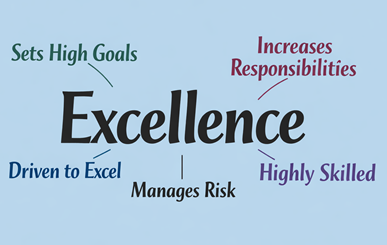
- Sets High Goals: the ambition and aspiration side of Excellence. It is about defining elevated standards, crafting stretch goals, and envisioning outcomes that push individuals and teams beyond routine expectations.
- Increases Responsibilities: the willingness to take on more in order to grow, contribute, and strengthen results. It is about stepping into additional duties, seeking challenging assignments, and assuming broader roles that build capability and support organizational needs.
- Visionary: an employee's ability to imagine and articulate a future state that elevates performance and expands what the team believes is possible. It is forward-looking, strategic, and rooted in big-picture thinking--identifying emerging trends, anticipating future needs, and translating long-range aspirations into clear priorities.
- Effectively Manages Risk: an employee's ability to balance ambition with sound judgment, ensuring that the pursuit of excellence is both bold and protected. This dimension is about anticipating obstacles, calibrating the right level of risk, and putting safeguards in place so high-quality outcomes are not compromised.
- Driven to Excel: the internal motivation, persistence, and personal ambition that fuel exceptional performance. It is about pride in one's work, relentless effort, and the determination to deliver superior results even when challenges arise.
- Pursuing Excellence: the drive, effort, and personal commitment to achieving the highest possible standards in every task. It is about producing exceptional work, outperforming expectations, and investing sustained energy to reach superior results.
- Objective Assessments: an employee's ability to evaluate performance (their and others) with clarity, accuracy, and honesty. It centers on recognizing how actions and results compare to expectations, identifying strengths and gaps, and using evidence--not assumptions--to understand what is working and what needs improvement.
- Highly Skilled: an employee's technical mastery, preparation, and depth of expertise--their ability to apply advanced knowledge, strong judgment, and well-developed skills to produce high-quality work. It is about being technically capable, staying current with evolving tools and methods, solving complex problems with confidence, and preparing thoroughly for key responsibilities.
- Continual Learning: an employee's commitment to expanding their knowledge, skills, and capabilities over time. It is about actively pursuing new learning opportunities, staying current with evolving tools and technologies, and engaging in structured development through courses, training, and real-world practice.
- Analytical Thinking: an employee's ability to understand complexity through logic, precision, and evidence-based interpretation. It is rooted in examining data, identifying patterns, refining analytical techniques, and extracting meaningful insights that strengthen decisions and outcomes.
- Boosting Creativity: an employee's ability to generate imaginative, original, and innovative ideas that elevate performance and reimagine how work is done. It is about applying creative insight to improve processes, design new solutions, challenge existing methods, and introduce fresh concepts that enhance excellence.
- Time Management: an employee's ability to prioritize, focus, and use time strategically to deliver high-value work efficiently and on schedule. It is about concentrating effort on the most important tasks, maintaining sustained focus, managing competing demands, and ensuring that deadlines and quality expectations are consistently met.
- Committed to Excellence: an employee's mindset and dedication to delivering consistently high-quality work, no matter the task or context. It is about bringing focus, discipline, and personal pride to every assignment--applying structured processes, maintaining high standards, and demonstrating unwavering commitment to producing exceptional outcomes.
- Increasing Productivity: an employee's efficiency, improvement orientation, and ability to maximize output without sacrificing quality. It is about continuously refining work practices, leveraging technology, tackling difficult tasks promptly, and keeping both themselves and others focused on improvement.
- Measures Progress: the discipline of tracking, evaluating, and adjusting work to ensure goals are met at a high standard. It is about monitoring milestones, reassessing progress as conditions change, and using objective measures to stay aligned with expectations.
Why is Excellence Important?
Excellence is essential in a company because it drives individuals to consistently deliver high-quality work, set ambitious goals, and push beyond routine expectations. Employees who embody excellence bring discipline, creativity, and strong analytical thinking to their roles, enabling them to solve complex problems, adapt to new challenges, and contribute meaningfully to organizational success. Their commitment to continual learning, skill development, and objective self-assessment ensures that performance steadily improves over time, raising the overall standard of work across the organization.
Excellence also strengthens the culture and long-term health of a company. Employees who take initiative, manage time effectively, and seek mentorship or professional connections help build a collaborative environment where people support one another and share knowledge. Their willingness to take on additional responsibilities, volunteer for critical tasks, and monitor progress toward goals ensures that teams remain aligned, productive, and resilient. When excellence becomes a shared expectation, organizations achieve stronger results, innovate more effectively, and maintain a competitive edge.
Excellence also strengthens the culture and long-term health of a company. Employees who take initiative, manage time effectively, and seek mentorship or professional connections help build a collaborative environment where people support one another and share knowledge. Their willingness to take on additional responsibilities, volunteer for critical tasks, and monitor progress toward goals ensures that teams remain aligned, productive, and resilient. When excellence becomes a shared expectation, organizations achieve stronger results, innovate more effectively, and maintain a competitive edge.
What are key aspects of Excellence?
- Sets High Goals
- Increases Responsibilities
- Visionary
- Effectively Manages Risk
- Driven to Excel
- Pursuing Excellence
- Objective Assessments
- Highly Skilled
- Continual Learning
- Analytical Thinking
- Boosting Creativity
- Time Management
- Committed to Excellence
- Increasing Productivity
- Measures Progress
- Mentorship
- Professional Contacts
- Volunteerism
How can I improve my Excellence?
- Model and reinforce high standards through clear goal-setting. A manager can improve excellence by setting ambitious, well-defined goals that challenge employees to stretch their capabilities. These goals should be tied to meaningful outcomes so employees understand the purpose behind the expectations. Managers should regularly communicate these standards and celebrate progress to keep motivation high.
- Expand responsibilities in a structured, developmental way. Assigning employees new or challenging responsibilities helps them build capability and confidence while contributing more meaningfully to the organization. Managers should match added responsibilities with coaching and support so employees feel equipped to succeed. Over time, this builds a culture where people proactively seek opportunities to grow.
- Promote a culture of learning, skill-building, and analytical thinking. Managers can encourage excellence by providing access to training, development programs, and opportunities to learn new tools or technologies. They should also model analytical thinking by using data to make decisions and encouraging employees to do the same. When learning becomes continuous, performance naturally rises.
- Strengthen excellence through creativity, innovation, and disciplined execution. Managers should create space for employees to propose new ideas, rethink processes, and experiment with creative solutions that elevate quality. At the same time, they must reinforce strong time-management habits so high-impact tasks are completed efficiently and at a high standard. Balancing innovation with disciplined execution helps teams deliver exceptional results.
- Use feedback, progress monitoring, and mentorship to drive continuous improvement. Managers should regularly assess progress toward goals, provide timely feedback, and help employees make adjustments that keep work on track. Encouraging mentorship--both giving and receiving--helps employees refine their skills and broaden their perspectives. This combination of feedback and guidance builds a cycle of improvement that strengthens excellence across the team.
- Leverage relationships and proactive contribution to elevate team performance. Managers can improve excellence by tapping into professional contacts who offer specialized knowledge, insights, or best practices that enhance outcomes. They should also model volunteerism by stepping up during critical moments and encouraging employees to support one another. When teams collaborate, share expertise, and contribute beyond their roles, excellence becomes a shared norm.
What are the benefits of Excellence in the workplace?
- Higher performance and stronger results. Employees with an excellence mindset consistently push beyond minimum expectations, producing work that is more accurate, thoughtful, and impactful. Their drive to achieve superior outcomes raises the overall performance level of the entire team.
- Greater adaptability and continuous improvement. These employees actively learn, refine their skills, and adjust their approaches based on feedback and changing conditions. Their commitment to growth helps the organization stay competitive and resilient in fast-moving environments.
- Stronger problem-solving and innovation. An excellence mindset encourages analytical thinking, creativity, and the willingness to explore better ways of working. This leads to improved processes, smarter decisions, and solutions that elevate quality and efficiency.
- A more reliable, motivated, and collaborative workforce. Employees who pursue excellence take ownership of their responsibilities and can be counted on to deliver high-quality work consistently. Their dedication also inspires colleagues, strengthening teamwork, trust, and shared accountability.
Employees who embrace excellence create a culture where high standards, continuous improvement, and strong results become the norm. Their mindset not only elevates their own performance but also enhances team effectiveness, organizational agility, and long-term success.
What questions could you consider for including on a 360-degree feedback assessment regarding Excellence?
360-Feedback questions that measure Excellence
Sets High Goals
Sets High Goals is about ambition, aspiration, and elevating performance. This dimension focuses on defining goals that stretch capability, raise standards, and inspire people to achieve more than routine expectations. It emphasizes forward-looking, aspirational targets--goals that expand skills, anticipate future needs, and transform high personal standards into exceptional performance. The core idea is setting a higher bar: clarifying what "excellent" looks like, pushing beyond comfort zones, and using challenging goals as a catalyst for growth and continuous improvement.
- Defines clear, aspirational goals that inspire higher levels of achievement.
- Sets goals with high standards to ensure work consistently exceeds expectations.
- Establishes ambitious performance goals that push beyond routine expectations and drive continuous improvement.
- Sets stretch goals to develop skills and abilities.
- Sets high standards across all tasks and responsibilities.
- Sets forward-looking goals that anticipate future needs and position the team for long-term success.
- Transforms high personal standards into exceptional performance.
- Sets goals to expand knowledge and skills.
- Raises the bar by setting goals that challenge existing capabilities and encourage meaningful growth.
Increases Responsibilities
Increases Responsibilities is about stepping forward and taking on more to build capability, strengthen contribution, and support the team. This dimension reflects initiative and ownership--seeking additional duties, accepting challenging assignments, assuming broader roles, and taking on extra responsibilities during critical periods. It is action-oriented rather than aspiration-oriented: demonstrating readiness to carry more weight, expand one's scope, and prepare for future leadership by embracing greater judgment, accountability, and complexity.
- Adds responsibilities for challenging assignments that expand capability and contribute to the bottom-line.
- Seeks opportunities to lead tasks or initiatives that require greater judgment, skill, or accountability.
- Accepts additional responsibilities.
- Assumes broader responsibilities to strengthen expertise and prepare for future leadership roles.
- Seeks additional responsibilities.
- Takes ownership of additional duties during critical periods to support the team.
Visionary
Visionary is about seeing ahead--imagining a compelling future, anticipating emerging trends, and inspiring people with a clear, ambitious direction. This dimension emphasizes big-picture thinking, innovation, and long-term opportunity: articulating a motivating vision, identifying future needs, and translating that foresight into priorities that elevate performance. A visionary leader expands possibilities, sets an ambitious future state, and motivates others to pursue higher levels of achievement by showing what excellence could look like.
- Articulates a compelling picture of the future that motivates others to pursue higher levels of performance.
- Sets an ambitious vision for the future.
- Envisions innovative approaches that elevate quality, efficiency, or impact.
- Identifies emerging trends and anticipates future needs to position the team for long-term success.
- Translates big-picture thinking into clear priorities that guide the team toward ambitious outcomes.
- Has a clear vision for success.
- Creates forward-looking plans to expand opportunities.
- Has a vision for how work should be completed in the department.
Effectively Manages Risk
Effectively Manages Risk is about navigating uncertainty in the pursuit of excellence. This dimension focuses on anticipating obstacles, calibrating the right level of risk, and putting safeguards in place to protect outcomes. It emphasizes judgment, balance, and disciplined decision-making--taking calculated risks that advance excellence while minimizing threats to quality, timelines, or results. A leader strong in this area ensures that bold ambitions are pursued responsibly, with controls, mitigation strategies, and thoughtful risk-reward assessments that keep performance on track.
- Mitigates risks that threaten the achievement of exceptional results.
- Takes calculated risks that are appropriate for achieving high-quality outcomes.
- Anticipates and minimizes risks that could compromise excellence.
- Implements controls and safeguards that maintain the quality of outcomes.
- Calibrates the level of risk required to achieve exceptional outcomes.
- Willing to take risks to achieve excellence.
- Strategically chooses the level of risk that maximizes the likelihood of exceptional results.
- Reduces potential obstacles and risks to ensure consistently exceptional performance.
- Assesses and selects the level of risk to enable superior performance.
- Limits the impact of risk events to protect performance and outcomes.
- Balances ambition and risk to drive outstanding results.
- Uses sound judgment to identify the risks that meaningfully advance excellence.
Driven to Excel
Driven to Excel is about internal motivation and sustained drive. This dimension reflects a deep, personal determination to achieve exceptional results, persist through challenges, maintain momentum, and push work to completion. It emphasizes pride in one's work, strong ambition, and an unwavering commitment to delivering superior performance across all tasks. The core idea is intensity of effort--a powerful internal engine that keeps someone striving, pushing, and persisting until the highest standards are met.
- Driven by a deep desire to excel.
- Takes a lot of pride in their work.
- Is driven to excel in all tasks and areas of responsibility.
- Shows unwavering determination to carry projects through to completion.
- Shows deep personal motivation to reach the highest standards.
- Models a strong drive for excellence that elevates team performance.
- Persists through challenges to ensure projects are fully completed.
- Demonstrates strong drive and persistence to see projects through to successful completion.
- Demonstrates a strong drive to accomplish tasks and deliver results.
- Consistently pushes toward superior performance.
- Demonstrates a strong internal drive to achieve exceptional results.
- Maintains momentum and focus to bring projects to completion.
- Channels ambition into actions that elevate quality and outcomes.
- Focuses on accomplishing meaningful work efficiently and effectively.
Pursuing Excellence
Pursuing Excellence is about the quality of the work itself and the deliberate effort invested in achieving exceptional outcomes. It focuses on aiming for the highest standards, producing high-quality work, striving for perfection, and taking initiative to elevate performance. This dimension emphasizes craftsmanship, continuous improvement, and a disciplined pursuit of exceptional quality. The core idea is intentional elevation of standards--actively working to improve results, refine output, and reach the highest level of performance in every endeavor.
- Strives for exceptional quality in every task undertaken.
- Pursues excellence with unwavering determination.
- Pursues the highest standards of performance.
- Produces high quality work.
- Aims to perform at the highest level in all endeavors.
- Models a determined pursuit of excellence that elevates team performance.
- Pursues excellence with sustained energy and determination.
- Invests the effort needed to achieve exceptional project results.
- Strives relentlessly to reach the highest standards.
- Pursues perfectionism in all endeavors.
- Takes the initiative to achieve higher standards.
- Consistently works to outperform expectations and benchmarks.
Objective Assessments
Objective Assessments is about how someone evaluates their own performance. The focus is on clarity, accuracy, and unbiased reflection--using evidence, data, and feedback to understand what is working, what isn't, and what needs to improve. This dimension is introspective and analytical: it emphasizes honest self-review, recognizing strengths and gaps, comparing results to expectations, and using objective insight as the foundation for continuous improvement. it is about evaluating performance with disciplined objectivity.
- Objectively analyzes performance to understand what is working and what needs improvement.
- Assesses performance objectively without bias.
- Evaluates performance with clarity, accuracy, and objectivity.
- Models objective self-evaluation as a foundation for continuous improvement.
- Uses evidence and data to evaluate personal performance and decision quality.
- Seeks objective feedback from others.
- Accurately recognizes how actions and results measure up to expectations.
- Reflects on recent work to determine which behaviors contributed to success and which hindered progress.
- Adjusts strategies based on honest self-review to continually raise performance standards.
- Regularly compares actual results to intended goals to identify gaps and improvement opportunities.
- Demonstrates clear self-awareness of strengths, gaps, and performance outcomes.
Highly Skilled
Highly Skilled is about the capability itself--the technical mastery, craftsmanship, preparation, and expertise required to consistently produce high-quality work. This dimension emphasizes applying advanced knowledge, staying current with evolving tools and technologies, solving complex problems with confidence, and delivering work that meets or exceeds professional standards. It is execution-focused: demonstrating strong functional skills, thorough preparation, and diligent effort that results in superior outcomes. it is about performing with technical excellence.
- Sets a high bar for technical accuracy and craftsmanship, consistently delivering work that meets or exceeds professional standards.
- Demonstrates the functional or technical skills necessary to do their job.
- Prepares thoroughly for key responsibilities--reviewing data, anticipating challenges, and planning effective approaches.
- Applies advanced knowledge and best practices to solve complex problems with accuracy and confidence.
- Ensures high-quality work by staying informed about new and evolving technologies.
- Continuously strengthens expertise through training, research, and hands-on application of new methods.
- Works diligently to produce high-quality results in all assignments.
- Continuously updates skills to keep pace with technological change.
- Uses strong analytical and technical judgment to make well-informed decisions that improve outcomes.
- Carefully prepares for any negotiations.
- Is planful and organized.
Continual Learning
Continual Learning is about expanding knowledge and skills over time. This dimension focuses on actively seeking out new learning opportunities--online courses, in-person training, continuing education, industry research, and lessons drawn from successes and failures. It emphasizes staying current with evolving technologies, investing in professional development, and modeling a commitment to lifelong learning. The core idea is growth through learning: deliberately building capability, staying up to date, and strengthening expertise through ongoing education and reflection.
- Pursues professional development through multiple learning channels to support excellence.
- Builds skills through structured online courses and in-person training.
- Stays up to date with evolving technologies and industry advancements.
- Strengthens expertise by participating in both digital and face-to-face learning experiences.
- Identifies lessons from successes and failures to strengthen decision-making.
- Engages in continuous learning through a mix of virtual and classroom-based instruction.
- Regularly seeks out new knowledge through multiple modes of training.
- Actively pursues ongoing learning through both online and in-person development opportunities.
- Pursues self-improvement through continuing education classes.
- Models a commitment to lifelong learning through active participation in online and in-person programs.
- Invests in ongoing education to elevate performance and maintain high standards.
- Invests in acquiring new skills.
- Adapts quickly to new tools, systems, and technological trends.
- Learns from both achievements and setbacks to improve future performance.
Analytical Thinking
Analytical Thinking is about how someone interprets information and solves problems. This dimension focuses on applying analytical techniques, refining data interpretation skills, identifying patterns and trends, and using evidence to understand complex issues more deeply. It emphasizes improving analytical methods, adopting advanced tools, and strengthening the precision and insightfulness of analysis. The core idea is clarity through analysis: using structured thinking and data-driven approaches to generate meaningful insights and improve decision-making.
- Adopts more advanced techniques to interpret data with greater precision.
- Demonstrates the analytical skills to do their job.
- Improves ability to find patterns, connections, and trends in data.
- Seeks to get a better understanding of complex issues and problems.
- Continuously refines data analysis skills to strengthen interpretation and insight.
- Improves analytical approaches to extract more meaningful and actionable insights.
- Updates analytical practices to keep pace with evolving data tools and techniques.
- Learns and applies new analytical methods to deepen data interpretation.
- Expands proficiency in analytical techniques to improve data-driven understanding.
- Improves the quality of analysis by strengthening techniques and interpretation skills.
- Expands proficiency in analytical techniques to improve data-driven understanding.
- Evaluates both successful and unsuccessful outcomes to extract meaningful insights.
Boosting Creativity
Boosting Creativity is about innovation, imagination, and generating new possibilities. This dimension focuses on producing novel ideas, reimagining established practices, and applying creative thinking to elevate quality, improve processes, and transform existing approaches. It emphasizes imaginative problem-solving--bringing forward fresh concepts, envisioning new ways to improve products or services, and proposing inventive solutions that raise standards. The core idea is creating something new or better: using creativity to enhance excellence and push work beyond conventional boundaries.
- Produces novel and valuable solutions to enhance excellence.
- Envisions creative ideas to improve products and services.
- Reimagines established practices by contributing fresh, creative ideas.
- Brings forward imaginative ideas that elevate the quality of products and services.
- Creates innovative products and services to improve excellence.
- Proposes inventive solutions that enhance or modernize current approaches.
- Generates innovative ideas that enhance performance and raise standards.
- Generates innovative ideas that transform and elevate existing approaches.
- Applies creative thinking to improve existing processes.
- Applies imaginative approaches to refine and advance existing practices.
- Applies creative thinking to elevate the quality of work and outcomes.
- Uses creative insight to redesign approaches for greater impact.
- Introduces new concepts that reimagine how work is done.
- Develops original ideas that challenge current methods.
Time Management
Time Management is about focus, discipline, and effective use of time. This dimension centers on prioritizing high-impact tasks, maintaining sustained attention, completing work within deadlines, and using time efficiently to support productivity and excellence. It emphasizes structured effort--devoting focused time to critical tasks, working diligently to finish assignments, and managing competing priorities to ensure timely, high-quality results. The core idea is using time wisely to achieve excellence: organizing work, maintaining momentum, and delivering strong outcomes through disciplined time allocation.
- Manages time effectively to achieve excellence in individual and departmental results.
- Applies focused effort to complete high-impact tasks at a high standard.
- Uses time efficiently to maintain productivity and support departmental excellence.
- Applies strong time-management skills to deliver high-quality results that strengthen departmental performance.
- Maintains sustained focus on critical tasks until the work is finished.
- Prioritizes work effectively--contributing to departmental success.
- Devotes focused time to high-priority tasks until they are successfully completed.
- Uses downtime or travel time to work on longer term projects.
- Achieves excellent results within the limited time constraints.
- Works quickly to complete tasks on time.
- Concentrates effort on the most important tasks to ensure timely completion.
- Works diligently on priority tasks until they are fully completed.
- Manages time strategically to complete high-value tasks that advance department goals.
- Prioritizes tasks to make the most efficient use of time.
- Uses time efficiently by delegating work to others.
- Focuses time on high-priority items.
- Regularly delivers results on time.
Committed to Excellence
Committed to Excellence is about dedication to quality and personal performance standards. This dimension reflects a deep, self-driven commitment to delivering top-tier results, applying structured processes, staying fully invested in project success, and consistently bringing energy and focus to produce high-quality outcomes. It emphasizes reliability, pride in workmanship, and an internal expectation of excellence--being the kind of person who can be counted on to add value and who strives to be the best version of themselves in every task.
- Demonstrates a strong commitment to achieving top-tier performance.
- Exhibits a self-driven commitment to excellence.
- Commits energy and focus to delivering a high-quality project outcome.
- Can be counted on to add value wherever they are involved.
- Applies structured processes to produce consistent, high-quality results.
- Demonstrates full commitment to ensuring the project's success.
- Shows a strong personal commitment to being the best they can be.
Increasing Productivity
Increasing Productivity is about efficiency, improvement, and output. This dimension focuses on constantly refining work practices, maximizing performance, leveraging technology, tackling difficult tasks without delay, and using clear productivity measures to improve results. It emphasizes continuous improvement and effective execution--keeping oneself and others focused on getting results now, ensuring quality standards are met, and making regular enhancements that increase output and strengthen performance.
- Keeps themselves and others focused on constant improvement.
- Makes regular improvements to maximize output.
- Tackles difficult projects head-on without delays.
- Leverages current technologies to enhance performance and outcomes.
- Uses firm measures of productivity to develop better work practices.
- Ensures quality standards are met.
- Constantly seeks to improve job performance.
Measures Progress
Measures Progress is about tracking work and evaluating how well goals are being met. This dimension focuses on checking whether tasks are on track, monitoring milestones, reassessing progress as conditions change, and using objective measures to understand performance. The emphasis is on clarity and alignment--regular evaluation, timely adjustments, and data-based insight to ensure work stays on course and meets high standards. it is about observing progress and correcting course to maintain excellence.
- Assesses progress to ensure goals are achieved at a high standard.
- Regularly evaluates progress toward goals to ensure work stays on track and aligned with expectations.
- Checks whether work is on track and makes timely adjustments.
- Uses objective measures to evaluate how well goals are being met.
- Reassesses progress toward goals as conditions change.
- Monitors progress toward key milestones.
Mentorship
Mentorship is about learning, guidance, and development through relationships with more experienced individuals. This dimension focuses on seeking mentor feedback, applying mentor-suggested strategies, discussing challenges to gain clarity, and using diverse perspectives to strengthen decision-making and elevate performance. The emphasis is on growth through guidance--building ongoing mentor relationships that support continuous learning, higher-quality solutions, and long-term development. It is about improving performance by learning from others, not by measuring progress directly.
- Engages with mentor feedback to elevate performance and pursue excellence.
- Actively uses mentor insights to strengthen skills and performance.
- Applies mentor-suggested strategies to improve work processes and elevate performance standards.
- Builds ongoing mentor relationships that support continuous learning and long-term development.
- Regularly discusses challenges with mentors to gain clarity and identify higher-quality solutions.
- Uses mentor perspectives to refine approaches and achieve higher standards.
- Seeks out mentors with diverse expertise to broaden perspective and strengthen decision-making.
- Welcomes guidance and feedback from mentors.
- Utilizes feedback from mentors.
- Uses mentor conversations to challenge assumptions and refine approaches for greater effectiveness.
- Actively seeks out mentors to gain insight, guidance, and professional growth.
Professional Contacts
Professional Contacts is about leveraging external expertise to elevate performance. This dimension focuses on building and maintaining relationships with industry peers, tapping into specialized knowledge, collaborating with professional networks, and drawing on others' insights to strengthen decisions, ideas, and outcomes. The emphasis is outward-facing: using professional relationships as strategic resources that enhance quality, broaden perspective, and support higher standards of excellence. It is fundamentally about improving results by accessing external knowledge and expertise.
- Draws on the insights of professional peers to support ongoing development and excellence.
- Taps into the skills of trusted contacts to elevate performance and problem-solving.
- Utilizes the strengths and expertise of professional networks to improve outcomes.
- Engages with professional contacts to access specialized knowledge that enhances work quality.
- Leverages professional relationships to achieve higher standards of excellence.
- Draws on the expertise and insights of others.
- Collaborates with professional contacts and associates in the industry to strengthen ideas, decisions, and results.
- Maintains a list of professional business contacts in the industry.
- Builds and maintains relationships with industry colleagues that support shared learning and improved performance.
Volunteerism
Volunteerism is about stepping forward internally to contribute beyond one's formal responsibilities. This dimension reflects initiative, dedication, and a willingness to support the team and organization--volunteering for challenging assignments, taking on leadership roles, helping during peak workloads, and proactively addressing problems before they escalate. The emphasis is action-oriented and service-driven: strengthening team performance, improving processes, and modeling reliability by choosing to contribute without being asked. It is fundamentally about elevating excellence through proactive, voluntary effort within the organization.
- Demonstrates excellence by proactively volunteering for tasks and initiatives that strengthen team performance, improve processes, and support organizational success.
- Sets an example of dedication, reliability, and willingness to contribute.
- Volunteers for challenging assignments that build new skills.
- Volunteers for tasks that advance team goals, even when they fall outside normal responsibilities.
- Volunteers for leadership roles.
- Supports colleagues during peak workloads as needed.
- Takes on pilot programs, new tools, or improvement efforts to help the organization grow.
- Encourages a culture where people step up and support one another.
- Steps forward to support important work without being asked.
- Identifies opportunities to contribute and takes action before problems escalate.