Self Management - Competency
Definition: Self‑Management is the ability to direct one's own behavior with clarity, discipline, and integrity -- showing self‑confidence in difficult moments, maintaining a positive attitude, and demonstrating self‑awareness and self‑control in interactions and decisions. It involves continuously developing oneself, setting and pursuing meaningful goals, seeking opportunities for growth, and taking full accountability for actions and outcomes. Strong self‑management is reflected in sustained focus, a strong work ethic, consistently high performance, and thorough preparation, supported by resilience, effective time management, thoughtful prioritization, and organized planning. At its core, it means keeping commitments and acting in a principled manner, ensuring that one's choices, behaviors, and follow‑through consistently model reliability, fairness, and professionalism.
Flexibility
Adaptability
Creativity
Accountability
Action
Bias for Action
Commitment
Integrity
Excellence
Self Management
Passion To Learn
Continual Learning
Creativity
Professional Development
Feedback
Punctuality
Attitude
Cultural Awareness
Emotional Intelligence
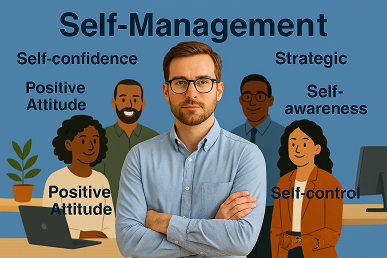
What is Self-Management?
Core Components of Self-Management
Why is Self-management important?
How can I improve my Self-management skills?
What are the benefits of having Self-management Skills?
Questions to include on your survey.
Core Components of Self-Management
Why is Self-management important?
How can I improve my Self-management skills?
What are the benefits of having Self-management Skills?
Questions to include on your survey.
360-Feedback Assessments Measuring Self-Management:
Survey 1 (4-point scale; Competency Comments)
Survey 2 (4-point scale; Competency Comments)
Survey 3 (5-point scale; Competency Comments)
Survey 4 (5-point scale; radio buttons)
Survey 5 (4-point scale; words)
Survey 6 (4-point scale; words)
Survey 7 (5-point scale; competency comments; N/A)
Survey 8 (3-point scale; Agree/Disagree words; N/A)
Survey 9 (3-point scale; Strength/Development; N/A)
Survey 10 (Comment boxes only)
Survey 11 (Single rating per competency)
Survey 12 (Slide-bar scale)
Survey 13 (4-point scale; numbers; floating anchors)
Survey 14 (4-point scale; N/A)
Survey 1 (4-point scale; Competency Comments)
Survey 2 (4-point scale; Competency Comments)
Survey 3 (5-point scale; Competency Comments)
Survey 4 (5-point scale; radio buttons)
Survey 5 (4-point scale; words)
Survey 6 (4-point scale; words)
Survey 7 (5-point scale; competency comments; N/A)
Survey 8 (3-point scale; Agree/Disagree words; N/A)
Survey 9 (3-point scale; Strength/Development; N/A)
Survey 10 (Comment boxes only)
Survey 11 (Single rating per competency)
Survey 12 (Slide-bar scale)
Survey 13 (4-point scale; numbers; floating anchors)
Survey 14 (4-point scale; N/A)
Self-Comments: Do you have to complete a self-assessment or performance appraisal? If so, the
self-comments here may help.
self-comments here may help.
Performance Management Assessments
that include Self-Management:
Assessment 1 (5-point scale; IDP Comments)
Assessment 2 (3-point scale with Comments)
Assessment 3 (Manager Assessment; 360-Feedback)
Assessment 4 (3-point scale; Rating Limits)
Assessment 5 (3-point scale; Rating Limits)
Assessment 6 (5-point scale with Comments)
Assessment 7 (Comment Boxes Only; IDP)
Assessment 8 (Comment Boxes Only)
Assessment 9 (3-point scale with Letter Grade)
Assessment 10 (360-Feedback; Bonus/Merit Pay)
Assessment 11 (Core Values & Job Competencies)
Assessment 12 (4-point scale; 6 Comment Boxes)
that include Self-Management:
Assessment 1 (5-point scale; IDP Comments)
Assessment 2 (3-point scale with Comments)
Assessment 3 (Manager Assessment; 360-Feedback)
Assessment 4 (3-point scale; Rating Limits)
Assessment 5 (3-point scale; Rating Limits)
Assessment 6 (5-point scale with Comments)
Assessment 7 (Comment Boxes Only; IDP)
Assessment 8 (Comment Boxes Only)
Assessment 9 (3-point scale with Letter Grade)
Assessment 10 (360-Feedback; Bonus/Merit Pay)
Assessment 11 (Core Values & Job Competencies)
Assessment 12 (4-point scale; 6 Comment Boxes)
What is Self-Management?
Self-Management is the capacity to direct one's own behavior with clarity, steadiness, and integrity, beginning with a foundation of self-confidence, a positive attitude, and strong emotional discipline. Individuals who excel in this area approach challenges with conviction, communicate with assurance, and maintain optimism and respect even under pressure. They demonstrate self-awareness by recognizing their own reactions, adjusting their communication to meet the needs of others, and managing emotions constructively to preserve trust, morale, and professionalism.
Self-Management also reflects a commitment to continuous growth and purposeful action. People strong in this competency actively pursue personal development, seek feedback, and build new skills while setting meaningful goals and breaking them into actionable steps. They look for opportunities to stretch their capabilities, challenge outdated routines, and take initiative before being asked. At the same time, they hold themselves accountable for results, demonstrate dependability during critical moments, and maintain focus by organizing work, protecting time for high-value tasks, and saying "no" to distractions that dilute performance.
Finally, Self-Management is expressed through disciplined execution and principled behavior. It includes a strong work ethic, consistently high performance, and thorough preparation--anticipating obstacles, planning ahead, and adapting smoothly when conditions change. Resilient individuals manage stress effectively, recover quickly from setbacks, and maintain momentum even when progress is slow or circumstances are unpredictable. At its core, Self-Management means keeping commitments and acting with fairness, honesty, and courage, ensuring that one's choices and follow-through consistently model reliability, professionalism, and ethical leadership.
Self-Management also reflects a commitment to continuous growth and purposeful action. People strong in this competency actively pursue personal development, seek feedback, and build new skills while setting meaningful goals and breaking them into actionable steps. They look for opportunities to stretch their capabilities, challenge outdated routines, and take initiative before being asked. At the same time, they hold themselves accountable for results, demonstrate dependability during critical moments, and maintain focus by organizing work, protecting time for high-value tasks, and saying "no" to distractions that dilute performance.
Finally, Self-Management is expressed through disciplined execution and principled behavior. It includes a strong work ethic, consistently high performance, and thorough preparation--anticipating obstacles, planning ahead, and adapting smoothly when conditions change. Resilient individuals manage stress effectively, recover quickly from setbacks, and maintain momentum even when progress is slow or circumstances are unpredictable. At its core, Self-Management means keeping commitments and acting with fairness, honesty, and courage, ensuring that one's choices and follow-through consistently model reliability, professionalism, and ethical leadership.
Core Components of Self-Management
- Self-confidence: a manager's belief in their own judgment, capability, and steadiness under pressure. It shows up in behaviors that project assurance--addressing conflict directly, making difficult decisions with conviction, navigating ambiguity without losing composure, and communicating expectations with clarity and authority.
- Positive Attitude: the emotional tone and outlook a manager brings to the environment. It reflects optimism, courtesy, hopefulness, and a constructive mindset--especially during stress or change.
- Self-awareness: an internal diagnostic skill: the ability to notice, understand, and interpret one's own emotions, triggers, biases, assumptions, and behavioral impact in real time. It involves recognizing how stress affects judgment, identifying when personal reactions might distort communication, and understanding how one's leadership style influences others.
- Self-control: the regulatory skill that follows from self-awareness: the ability to manage, modulate, and direct one's emotions and behaviors so they remain constructive, professional, and steady under pressure. It shows up in behaviors like staying calm during conflict, avoiding impulsive reactions, stepping away to reset before responding, and maintaining emotional steadiness even when criticized or frustrated.
- Personal Development: a manager's ongoing growth, learning, and self-improvement by expanding capability through feedback, reflection, training, mentorship, and deliberate skill-building. A manager strong in Personal Development actively seeks coaching, identifies gaps in their knowledge, pursues learning opportunities, and engages in honest self-assessment to understand how their behavior affects others.
- Goals and Objectives: what the manager is trying to achieve--the structured, disciplined process of setting targets, defining success criteria, breaking goals into actionable steps, and tracking progress. It reflects a manager's ability to create clear performance objectives, maintain focus, monitor milestones, and adjust plans to stay aligned with priorities.
- Opportunity Seeking: expansion, initiative, and forward momentum through a manager's drive to stretch beyond the current scope of work--actively pursuing new challenges, identifying unmet needs, experimenting with better methods, and stepping into high-visibility or developmental assignments. This facet is exploratory and growth-oriented: the manager scans for emerging trends, challenges existing routines, and takes initiative before being asked.
- Accountability: ownership of actions, decisions, and outcomes through a manager's willingness to take responsibility for their performance, follow through on commitments, and acknowledge mistakes without defensiveness. Someone strong in Accountability is dependable during critical moments, stands by difficult choices, and treats errors as opportunities for learning and improvement.
- Focused: discipline, sustained attention, and execution through a manager's ability to stay locked onto priorities, avoid distractions, break work into manageable steps, and maintain concentration through complexity, interruptions, or slow progress.
- Strong Work Ethic: the effort, discipline, and personal drive a manager brings to their work. It reflects persistence through difficulty, steady productivity across changing conditions, and a commitment to doing work thoroughly and with care.
- High Performance: the results that effort produces--consistently delivering outcomes that exceed expectations through accuracy, efficiency, timeliness, and the ability to produce high-quality work under pressure or ambiguity.
- Well Prepared: anticipation, organization, and readiness through a manager's ability to foresee needs, plan ahead, and create the conditions for smooth execution.
Why is Self-management important?
Self-Management is important because it enables employees and leaders to operate with consistency, clarity, and reliability without requiring constant oversight. When individuals demonstrate self-confidence, emotional discipline, and a positive attitude, they communicate more effectively, navigate conflict constructively, and maintain professionalism even under pressure--behaviors that stabilize teams and reduce friction. Their self-awareness and self-control help them adapt their approach to different people and situations, preserving trust and morale while preventing small issues from escalating into larger problems. In short, strong self-management strengthens the interpersonal fabric of an organization, creating a more respectful, resilient, and collaborative environment.
It also drives performance and long-term organizational success. People who set meaningful goals, seek opportunities to grow, and hold themselves accountable consistently produce higher-quality work with fewer delays, errors, or crises. Their ability to prioritize, manage time, plan ahead, and stay focused ensures that resources are used wisely and that critical work moves forward even in the face of change or uncertainty. When employees are principled, dependable, resilient, and committed to continuous improvement, they model the kind of integrity and disciplined execution that builds organizational credibility, strengthens culture, and enables teams to achieve ambitious goals together.
It also drives performance and long-term organizational success. People who set meaningful goals, seek opportunities to grow, and hold themselves accountable consistently produce higher-quality work with fewer delays, errors, or crises. Their ability to prioritize, manage time, plan ahead, and stay focused ensures that resources are used wisely and that critical work moves forward even in the face of change or uncertainty. When employees are principled, dependable, resilient, and committed to continuous improvement, they model the kind of integrity and disciplined execution that builds organizational credibility, strengthens culture, and enables teams to achieve ambitious goals together.
How can I improve my Self-management skills?
- Build stronger self-awareness by regularly reflecting on your reactions, habits, and patterns. Notice when your emotions, assumptions, or communication style are helping or hindering your effectiveness. Use that insight to adjust your approach in real time so you stay aligned with your goals and values.
- Strengthen your time management by structuring your day around high-value work. Protect blocks of focused time and avoid letting interruptions dictate your schedule. Review your calendar weekly to ensure your time reflects your priorities rather than your inbox.
- Improve prioritization by consistently choosing what matters most, not what feels easiest. Reassess your priorities when new information or demands arise so you stay aligned with long-term goals. Practice saying "no" or renegotiating commitments when lower-value tasks threaten to dilute your focus.
- Develop better planning and organization systems that support clarity and follow-through. Use tools (digital or physical) that help you track tasks, deadlines, and progress. Keep your workspace and digital files orderly so you can access what you need quickly and avoid unnecessary friction.
- Enhance your resilience by learning to reset quickly after setbacks or stress. When challenges arise, focus on what you can control rather than dwelling on what you can't. Build habits (like pausing, seeking input, or reframing obstacles) that help you stay steady and solution-oriented.
- Strengthen accountability by owning your commitments and following through reliably. Communicate early when expectations need to shift so trust remains intact. Treat mistakes as data, not failures, and use them to refine your approach going forward.
- Invest in personal development by seeking feedback, coaching, and stretch opportunities. Set specific growth goals and break them into small, consistent actions you can practice over time. Look for chances to expand your skills, challenge outdated routines, and push yourself into new territory.
What are the benefits of having Self-management Skills?
- Self-management enables managers to lead with steadiness and credibility. When managers regulate their emotions and maintain composure under pressure, they create psychological safety for their teams. This steadiness builds trust, reduces unnecessary conflict, and helps employees feel confident in their leader's judgment.
- It allows managers to operate independently and reliably without constant oversight. Leaders who manage their time, priorities, and commitments effectively keep work moving even in complex or ambiguous situations. Their reliability reduces bottlenecks, strengthens team performance, and ensures that critical responsibilities are handled consistently.
- Strong self-management enhances a manager's ability to make sound decisions. When leaders stay focused, organized, and self-aware, they can evaluate information more clearly and avoid reactive or impulsive choices. This leads to better strategic thinking, more thoughtful problem-solving, and decisions that align with long-term goals.
- It sets a powerful behavioral example that shapes team culture. Employees tend to mirror the habits, discipline, and professionalism they observe in their leaders. When managers demonstrate accountability, resilience, and principled behavior, they elevate expectations and inspire teams to adopt the same standards.
- Self-management directly improves productivity and execution across the organization. Managers who plan ahead, prioritize effectively, and stay focused on high-value work help their teams avoid chaos, rework, and wasted effort. Their disciplined approach ensures that goals are met on time, resources are used wisely, and performance remains strong even during periods of change.
What questions could be included on a 360-degree survey that measure Self-management?
Questions to include on your survey.
Self-confidence
Self-confidence is fundamentally about a manager's belief in their own judgment, capability, and steadiness under pressure. It shows up in behaviors that project assurance--addressing conflict directly, making difficult decisions with conviction, navigating ambiguity without losing composure, and communicating expectations with clarity and authority. A self-confident manager takes initiative on complex tasks, stands by their reasoning while remaining open to input, and delegates with trust because they believe in their own ability to guide outcomes. The core energy here is inner certainty: a grounded sense of competence that allows the manager to act decisively, remain composed in stressful moments, and inspire confidence in others through their steadiness.
- Demonstrates confidence in personal judgment while remaining open to input and alternative perspectives.
- Demonstrates belief in their own competence by taking the initiative on complex or high-visibility tasks.
- Models self-assurance that encourages employees to take risks, stretch their abilities, and trust their own judgment.
- Maintains confidence and composure during stressful times.
- Displays confidence in their ability to navigate ambiguity and guide others through it.
- Approaches challenging decisions with clarity and conviction, even when the path forward is uncertain.
- Shows confidence in delegating responsibilities, trusting others while remaining accountable for outcomes.
- Demonstrates confidence in navigating ambiguity, making thoughtful decisions even when information is incomplete.
- Communicates progress and setbacks transparently, without fear of judgment, reflecting confidence in their leadership.
- Is courageous and confident when leading the department.
- Maintains a high degree of self-management to inspire and influence subordinates.
- Addresses conflicts directly and constructively, showing assurance in their ability to resolve issues.
- Communicates expectations and direction with a steady, assured tone that instills trust in the team.
- Is able to give confidence to others by maintaining own composure.
Positive Attitude
Positive Attitude is about the emotional tone and outlook a manager brings to the environment. It reflects optimism, courtesy, hopefulness, and a constructive mindset--especially during stress or change. A manager with a positive attitude maintains a can-do approach, treats others respectfully, models calm and optimism, and intentionally shapes team morale through their demeanor. While self-confidence is about believing "I can handle this," positive attitude is about conveying "We can get through this, and it's worth staying hopeful." The emphasis is on emotional contagion--projecting stability, encouragement, and optimism so the team feels supported, energized, and resilient.
- Sets an example for associates during stressful periods by maintaining a positive, can-do attitude.
- Is optimistic and hopeful about the future even when progress is difficult or uncertain.
- Projects a consistent sense of stability that reassures employees during organizational change.
- Understands how their attitude affects team morale and adjusts behavior to maintain a constructive environment.
- Is courteous and respectful to coworkers/colleagues.
- Is more optimistic than pessimistic.
- Steps into high-pressure situations without hesitation, modeling steadiness for the team.
- Remains optimistic and hopeful about the future despite obstacles to progress.
- Demonstrates optimism and determination when facing repeated obstacles, modeling perseverance for others.
- Sets an example for others during stressful periods by maintaining a positive, can-do attitude.
- Thinks clearly, positively, and calmly.
Self-awareness
Self-awareness is fundamentally an internal diagnostic skill: the ability to notice, understand, and interpret one's own emotions, triggers, biases, assumptions, and behavioral impact in real time. It involves recognizing how stress affects judgment, identifying when personal reactions might distort communication, and understanding how one's leadership style influences others. A self-aware manager monitors their tone, body language, and decision patterns, reflects on past choices, and adjusts their approach based on insight. In essence, self-awareness is about seeing oneself clearly--understanding what is happening internally and how that internal state shapes outward behavior.
- Analyzes own reactions on the spot to ensure that communication does not appear to be driven by anger.
- Is aware of personal impact on others and adjusts behavior to create a positive leadership presence.
- Recognizes personal emotional triggers and takes steps to regulate responses before engaging with others.
- Notices when stress or fatigue is affecting judgment and takes corrective action to maintain professionalism.
- Demonstrates insight into how their leadership style influences team performance and adapts accordingly.
- Reflects on personal strengths and limitations and adjusts approach to ensure effective leadership.
- Demonstrates awareness of personal biases and works to prevent them from influencing decisions.
- Recognizes when personal assumptions may be incorrect and reconsiders them based on new information.
- Adjusts communication style when sensing that others are confused, overwhelmed, or disengaged.
- Monitors tone, body language, and nonverbal cues to ensure messages are conveyed with respect and clarity.
- Analyzes interpersonal problems instead of reacting to them.
- Reflects on the impact of past decisions to improve future decision-making.
Self-control
Self-control is the regulatory skill that follows from self-awareness: the ability to manage, modulate, and direct one's emotions and behaviors so they remain constructive, professional, and steady under pressure. It shows up in behaviors like staying calm during conflict, avoiding impulsive reactions, stepping away to reset before responding, and maintaining emotional steadiness even when criticized or frustrated. A manager with strong self-control prevents their emotions from disrupting others, uses patience intentionally, and responds with maturity rather than defensiveness. Where self-awareness is about recognizing what you feel and why, self-control is about choosing how you act despite what you feel.
- Deals with conflict by controlling own emotions by listening, being flexible, and sincere in responding.
- Does not allow own emotions to interfere with the performance of others.
- Steps away from a situation to process appropriate response.
- Uses patience and self-control in working with customers and associates.
- Maintains emotional control during criticism or disagreement, responding with maturity rather than defensiveness.
- Consciously controls own negative emotions in order to keep team morale up.
- Does not act impulsively.
- Avoids disruptive outbursts when correcting the work of subordinates.
- Does not show frustration when confronted with difficult issues.
- Maintains professionalism and composure when confronted with criticism, conflict, or unexpected demands.
- Maintains emotional steadiness during prolonged periods of uncertainty, allowing the team to stay grounded.
- Demonstrates emotional steadiness that supports consistent output.
- Maintains control of their bearing and personal appearance.
- Has a stable and balanced mood at work.
- Deals with conflicts by controlling their own emotions, listening, and by being flexible and sincere in their responses.
- Is calm and rational in their behaviors.
Personal Development
Personal Development is about a manager's ongoing growth, learning, and self-improvement by expanding capability through feedback, reflection, training, mentorship, and deliberate skill-building. A manager strong in Personal Development actively seeks coaching, identifies gaps in their knowledge, pursues learning opportunities, and engages in honest self-assessment to understand how their behavior affects others. The emphasis is on curiosity, self-discovery, and long-term professional evolution. In essence, Personal Development is inward-facing: it's the continuous effort to strengthen one's competence, insight, and leadership capacity over time.
- Pursues professional development opportunities that strengthen long-term effectiveness.
- Continuously seeks new skills and abilities through training and development opportunities.
- Seeks out opportunities to receive training, mentorship, and coaching.
- Actively seeks mentorship, coaching, or peer learning to strengthen professional skills.
- Seeks feedback from colleagues and employees to better understand how their behavior is perceived.
- Creates development goals based on feedback, reflection, or performance reviews.
- Willingly engages in self-assessment and discovery.
- Seeks their full potential through self-development.
- Creates structured plans for personal improvement and skill development.
- Seeks coaching from experienced professionals.
- Identifies gaps in their own knowledge and takes deliberate steps to close them.
- Seeks out knowledge and develops skills to advance themselves.
Goals and Objectives
Goals and Objectives is about what the manager is trying to achieve--the structured, disciplined process of setting targets, defining success criteria, breaking goals into actionable steps, and tracking progress. It reflects a manager's ability to create clear performance objectives, maintain focus, monitor milestones, and adjust plans to stay aligned with priorities. This facet is more operational and execution-oriented: it's about organizing work, maintaining momentum, and ensuring accountability for results. Where Personal Development is about growth of the self, Goals and Objectives is about directing that growth toward concrete, measurable outcomes.
- Establishes clear personal performance objectives that guide daily decisions and long-term development.
- Sets challenging personal goals that stretch capability while remaining achievable.
- Sets goals related to personal leadership growth, emotional regulation, or interpersonal effectiveness.
- Establishes objectives for improving decision-making, time management, or productivity.
- Sets ambitious but attainable goals.
- Defines personal success criteria to ensure accountability for their own performance.
- Sets SMART goals for the team.
- Reviews personal goals periodically to ensure alignment with evolving responsibilities and organizational priorities.
- Has personal goals and objectives.
- Monitors progress toward personal objectives and adjusts plans when needed to stay on track.
- Breaks long-term goals into clear milestones and monitors progress toward them.
- Regularly sets short-term and long-term goals to maintain focus and momentum in their own work.
- Establishes clear milestones to measure progress toward personal and team objectives.
- Breaks personal goals into actionable steps and schedules time to work toward them consistently.
Opportunity Seeking
Opportunity Seeking is about expansion, initiative, and forward momentum through a manager's drive to stretch beyond the current scope of work--actively pursuing new challenges, identifying unmet needs, experimenting with better methods, and stepping into high-visibility or developmental assignments. This facet is exploratory and growth-oriented: the manager scans for emerging trends, challenges existing routines, and takes initiative before being asked. The underlying energy is outward-facing and future-focused--seeking ways to elevate personal capability, improve processes, and contribute at a higher level. In short, Opportunity Seeking is about creating new possibilities and intentionally pushing into new territory.
- Seeks opportunities to achieve success.
- Identifies opportunities to contribute beyond formal responsibilities.
- Actively looks for new challenges, responsibilities, or learning experiences to expand personal capability.
- Pursues stretch assignments that build new capabilities and broaden leadership experience.
- Volunteers for complex or high-visibility projects to accelerate personal development.
- Identifies emerging trends or needs and takes initiative before being asked.
- Spots unmet needs or inefficiencies and takes initiative to address them.
- Takes responsibility for personal growth by actively seeking opportunities to develop emotional and interpersonal skills.
- Acts quickly when a promising opportunity arises, rather than waiting for direction.
- Regularly seeks ways to improve processes, skills, or outcomes through experimentation or innovation.
- Experiments with new methods or tools to improve personal efficiency and effectiveness.
- Challenges existing routines and looks for better ways to accomplish work.
Accountability
Accountability is about ownership of actions, decisions, and outcomes through a manager's willingness to take responsibility for their performance, follow through on commitments, and acknowledge mistakes without defensiveness. Someone strong in Accountability is dependable during critical moments, stands by difficult choices, and treats errors as opportunities for learning and improvement. The emphasis is on integrity and reliability--doing what they said they would do, meeting expectations without needing reminders, and demonstrating professionalism when things go wrong. In short, Accountability is about answering for results and consistently showing that one's word and actions can be trusted.
- Takes full responsibility for their performance.
- Acknowledges mistakes openly and uses them as opportunities for learning and improvement.
- Acknowledges mistakes openly and takes corrective action promptly.
- Takes responsibility for personal decisions and follows through on commitments without needing reminders.
- Is responsible for performance.
- Demonstrates dependability that others can count on during critical moments.
- Takes responsibility for difficult choices and stands by them with professionalism and poise.
- Is conscientious about doing a good job.
- Holds themself accountable for results.
Focused
Focused is about discipline, sustained attention, and execution through a manager's ability to stay locked onto priorities, avoid distractions, break work into manageable steps, and maintain concentration through complexity, interruptions, or slow progress. This facet is about depth rather than breadth--protecting time for deep work, staying mentally present, and saying "no" to lower-value tasks to ensure consistent progress on what matters most. The underlying energy is inward-facing and task-anchored--ensuring that goals are completed efficiently and without drift. In short, Focused is about following through with precision and maintaining steady progress toward defined objectives.
- Stays focused on long-term goals despite short-term frustrations, delays, or competing pressures.
- Maintains concentration during long or complex tasks, even when progress is slow or obstacles arise.
- Maintains attention on high-priority tasks and avoids distractions that interfere with progress.
- Is able to stay focused until the task is completed.
- Breaks complex tasks into manageable steps and stays focused until completion.
- Quickly regains focus after interruptions or unexpected disruptions.
- Stays mentally present in meetings, discussions, and work sessions, avoiding multitasking that dilutes effectiveness.
- Saves time for deep work and avoids unnecessary interruptions.
- Organizes work to ensure consistent forward movement on key objectives.
- Is capable of independently working on tasks without getting distracted.
- Able to stay focused on important goals by saying "no" to less important goals and requests.
Strong Work Ethic
Strong Work Ethic is about the effort, discipline, and personal drive a manager brings to their work. It reflects persistence through difficulty, steady productivity across changing conditions, and a commitment to doing work thoroughly and with care. A manager with a strong work ethic avoids busy work, stays consistent on long-term goals, takes initiative to solve problems, and demonstrates an internal motivation to excel--not because someone is watching, but because they hold themselves to high personal standards. The emphasis is on how the person approaches work: with dedication, discipline, reliability, and sustained effort, even when tasks are tedious or conditions are challenging.
- Shows dedication by completing work thoroughly and with care.
- Demonstrates persistence and effort even when tasks are difficult or tedious.
- Demonstrates a strong internal drive to excel, not just to meet requirements.
- Maintains steady progress on long-term goals by working on them consistently rather than sporadically.
- Maintains steady productivity across busy, slow, or unpredictable periods.
- Avoids "busy work" and concentrates on activities that meaningfully advance goals.
- Always exhibits a strong work ethic.
- Goes beyond minimum expectations when needed to ensure success.
- Produces results that require minimal rework, demonstrating strong personal standards.
- Takes initiative to solve problems independently before they escalate.
- Accomplishes tasks in difficult and challenging situations.
- Approaches responsibilities with discipline, consistency, and a commitment to quality.
- Maintains consistent performance even when personal workload, team dynamics, or external pressures intensify.
- Understands what steps are needed to perform up to expectations.
High Performance
High Performance is about the results that effort produces--consistently delivering outcomes that exceed expectations through accuracy, efficiency, timeliness, and the ability to produce high-quality work under pressure or ambiguity. A high-performing manager completes tasks thoroughly the first time, streamlines workflows, sets ambitious performance benchmarks, and maintains exceptional output even during setbacks or stress. This facet is outcome-oriented: it focuses on achieving superior results, improving performance over time, and using systems or routines that support sustained excellence. High Performance is about the output (quality, consistency, and above-expectation results).
- Sets personal performance benchmarks that exceed minimum expectations.
- Maintains consistently high levels of performance.
- Completes tasks thoroughly the first time, reducing the need for oversight.
- Demonstrates reliability by completing tasks on time and to expected quality standards.
- Delivers high-quality work even under tight deadlines or challenging conditions.
- Consistently performs above expectations.
- Maintains high performance even when facing setbacks, stress, or ambiguity.
- Holds self to high standards of reliability and delivers on promises consistently.
- Pushes themselves to improve outcomes, even when external pressure is low.
- Uses tools, systems, or routines that support sustained high performance.
- Takes responsibility for ensuring work is completed accurately and on schedule.
- Streamlines personal workflows to increase efficiency and reduce delays.
- Focuses on achieving results.
Well Prepared
Well Prepared is about anticipation, organization, and readiness through a manager's ability to foresee needs, plan ahead, and create the conditions for smooth execution. This includes preparing thoroughly for meetings, maintaining an organized workspace, scanning for emerging trends, anticipating obstacles, and developing skills before they become essential. A well-prepared manager tests ideas before scaling them, presents recommendations backed by thoughtful reasoning, and positions themselves proactively for change. The emphasis is on foresight and structure--ensuring that work is not only completed, but completed efficiently because the groundwork has been laid. In short, Well Prepared is about being ready before the moment arrives.
- Scans the environment for emerging trends and positions themselves to take advantage of them.
- Anticipates future skill requirements and begins developing them before they become essential.
- Recognizes early signs of organizational change and prepares accordingly.
- Is generally prepared and on-time for meetings.
- Anticipates upcoming needs, deadlines, and challenges, and prepares accordingly.
- Anticipates potential obstacles and adjusts plans to maintain performance.
- Workspace is clean and organized.
- Initiates small-scale pilots or tests to explore new approaches before rolling them out more broadly.
- Takes charge of situations.
- Presents ideas and recommendations assertively, backed by thoughtful reasoning and preparation.
- Maintains a clean and organized workspace.
Resilient
Resilience is about responding to pressure, setbacks, and uncertainty with emotional steadiness, adaptability, and the ability to maintain forward momentum even when conditions are difficult. A resilient manager handles high stress without becoming overwhelmed, recovers quickly from mistakes, reframes challenges as opportunities, and "resets" after difficult interactions. They stay solution-oriented during crises, adjust calmly to unexpected changes, and use constructive coping strategies to maintain clarity under pressure. The core energy here is bounce-back strength: the capacity to stay grounded, flexible, and motivated despite obstacles, ambiguity, or adversity.
- Responds to unexpected changes with flexibility, adjusting plans without losing momentum or motivation.
- Recovers quickly from setbacks, maintaining a calm and solution-focused demeanor.
- Recovers quickly from mistakes and uses them as fuel for improvement.
- Quickly adapts to new expectations, technologies, or organizational shifts without becoming overwhelmed.
- Demonstrates persistence by continuing to make progress even when progress is slow or obstacles accumulate.
- Remains solution-oriented during crises, focusing on what can be controlled rather than dwelling on setbacks.
- Uses constructive coping strategies (such as prioritizing, pausing, or seeking input) to maintain clarity under pressure.
- Reframes challenges as opportunities to learn, innovate, or strengthen processes rather than as setbacks.
- Demonstrates the ability to "reset" after difficult interactions, returning to tasks with renewed focus and calm.
- Able to handle a high level of stress.
- Understands how to identify and correct problems.
- Effectively manages stress in the workplace.
- Identifies potential obstacles to personal goals and proactively develops strategies to overcome them.
- Seeks feedback after challenging situations to refine strategies and strengthen future resilience.
- Able to handle unexpected events and issues.
Time Management
Time Management is about how a manager structures their work to use time effectively and consistently meet expectations using planning, scheduling, and disciplined execution--allocating time appropriately, protecting high-value work periods, balancing multiple responsibilities, and avoiding last-minute rushes. A manager strong in Time Management uses calendars and systems to stay on track, adjusts schedules when priorities shift, and structures the workday to minimize distractions. The core energy here is intentional control of time: organizing tasks and workflow so that deadlines are met, quality is maintained, and productivity remains steady.
- Uses schedules, calendars, or project management systems to ensure deadlines are consistently met.
- Manages time effectively by structuring the day around high-value tasks rather than reacting to interruptions.
- Adjusts the schedule when priorities shift, ensuring critical tasks still receive adequate attention.
- Structures the workday to protect time for high-value activities and minimize low-value tasks.
- Manages time effectively to maximize output without sacrificing quality.
- Balances multiple responsibilities without letting any area fall behind.
- Manages time well.
- Allocates appropriate time for complex work and avoids last-minute rushes by planning ahead.
- Schedules time for intense work periods and honors them consistently.
- Effective in managing time.
Prioritization
Prioritization is fundamentally about choosing what matters most and directing attention, time, and energy toward the highest-value work. It reflects a manager's ability to distinguish essential tasks from lower-value activities, make informed trade-offs when demands compete, and stay focused on the work that drives the strongest results. Someone strong in Prioritization completes tasks in order of importance rather than convenience, regularly reassesses what deserves attention, and is willing to say "no" to distractions or unnecessary projects. The core of this competency is decision-making under constraint--ensuring that limited time and resources are consistently applied to the most impactful work.
- Prioritizes tasks in a way that consistently leads to strong results.
- Identifies the most important tasks and focuses on them before addressing lower-value activities.
- Quickly distinguishes between urgent issues and those that can be deferred or delegated.
- Reviews priorities regularly to ensure attention remains on the most impactful tasks.
- Completes tasks in order of importance rather than convenience or preference.
- Maximizes the value of work.
- Makes informed trade-offs when competing demands arise, ensuring essential work is completed first.
- Maintains focus on doing the best quality work even if it requires saying "no" to unnecessary, or unrelated, projects.
- Reassesses priorities regularly to stay on top of changing goals or conditions.
- Prioritizes essential tasks.
Planning/Organization
Planning/Organization is about structuring work so it can be executed efficiently and predictably through a manager's ability to create plans, organize information, maintain orderly systems, and prepare for future needs or obstacles. This includes using calendars and task systems, keeping workspaces and digital files organized, developing contingency plans, and structuring processes to reduce confusion or rework. Someone strong in Planning/Organization anticipates risks, aligns plans with broader goals, and maintains the discipline needed to keep work flowing smoothly. The core of this competency is creating clarity and order--ensuring that tasks, tools, and processes are arranged in a way that supports consistent, high-quality execution.
- Uses planning tools (calendars, task lists, blockers) to maintain clarity on what must be accomplished each day.
- Effective in planning and organizing projects and enterprises.
- Aligns personal plans with broader organizational goals to ensure long-term contribution.
- Structures work processes to minimize confusion, duplication, or rework.
- Plans and organizes work within the department.
- Creates a plan for successful completion of the project.
- Is well organized.
- Keeps documents, tools, and information logically arranged so they can be accessed quickly.
- Adjusts plans proactively when new information, risks, or opportunities emerge.
- Uses calendars, task systems, or tracking tools to organize and manage personal goals effectively.
- Develops contingency plans to ensure continuity when unexpected obstacles arise.
- Maintains an orderly workspace and digital environment that supports efficiency and reduces wasted time.
Keeps Commitments
Keeps Commitments is about reliability, follow-through, and personal ownership of obligations reflecting a manager's ability to deliver work on time, meet expectations consistently, and honor promises without needing reminders or oversight. Someone strong in this area tracks their commitments, communicates proactively when adjustments are needed, and maintains momentum even when juggling multiple responsibilities or facing pressure. The emphasis is on dependability--doing what they said they would do, taking responsibility for outcomes, and ensuring that others can count on them during critical moments. In short, Keeps Commitments is about being trustworthy through consistent action and follow-through.
- Keeps all promises and commitments.
- Tracks personal commitments and ensures deadlines are met even when challenges arise.
- Follows through on commitments without needing reminders or supervision.
- Shows discipline in meeting commitments regardless of external pressures.
- Follows through on commitments without losing momentum, even when juggling multiple responsibilities.
- Takes responsibility for outcomes and does not shift blame when expectations are not met.
- Keeps commitments.
- Stays on top of current commitments.
- Follows through on promises and responsibilities without needing reminders or oversight.
- Communicates proactively when commitments need to be adjusted, ensuring transparency and trust.
- Delivers work on time and to the expected standard, even when challenges arise.
- Demonstrates reliability that others can depend on during critical or high-pressure moments.
Principled
Principled is about ethical judgment, fairness, and value-driven decision-making reflecting a manager's ability to act with integrity, maintain honesty in difficult conversations, and uphold ethical standards even when doing so is unpopular or inconvenient. A principled manager treats others with respect, stands by ethical choices, and declines poor or unethical strategies--even when pressured to go along. The emphasis is on moral courage and consistency--making decisions rooted in values rather than expedience. In short, Principled is about being trustworthy through integrity, fairness, and adherence to ethical standards.
- Maintains strong adherence to ethics and values.
- Holds themselves accountable to high personal standards, regardless of external pressure.
- Maintains honesty and transparency in communication, especially when delivering difficult messages.
- Makes decisions based on clear values and ethical standards, even when doing so is difficult.
- Acts consistently and fairly, treating all colleagues with respect and integrity.
- Demonstrates courage by standing by ethical choices, even when they are unpopular.
- Is able to decline bad ideas to avoid making poor decisions.
- Able to decline a poor strategy by proposing alternate strategies.