Survey Questions: Entrepreneurship
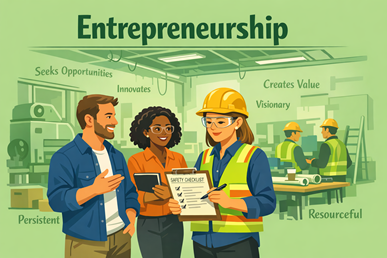
Definition: Entrepreneurship is the disciplined ability to recognize opportunities in emerging trends and translate them into action while innovating through new ideas, offerings, and ways of working that strengthen the organization's competitive edge. It creates value by developing products, services, and solutions that advance strategic goals, all anchored in a compelling vision that energizes people to explore new possibilities. Entrepreneurs navigate ambiguity with confidence, strategic insight, and learning agility, drawing on independence, resourcefulness, interpersonal relationships, and thoughtful risk taking to move initiatives forward despite uncertainty or adversity. Ultimately, entrepreneurship is defined by initiative, persistent execution, and the ability to deliver results--turning promising concepts into measurable progress that drives organizational success.
Leadership
Supervision
Supervisor
Establishing Focus/Direction
Empowering Others
Project Management
Conflict Management
Change Management
Strategic Focus
Vision
Example Questionnaires with Entrepreneurship:
Example 1 (5-point scale; numbers; NA)
Example 2 (7-point scale; radio buttons)
Example 3 (4-point scale; radio buttons)
Example 4 (5-point scale; radio buttons)
Example 5 (5-point scale; words)
Example 6 (Pulse Survey)
Example 7 (5-point scale; item comments)
Example 8 (3-point scale; words; N/A)
Example 9 (4-point scale; numbers)
Example 10 (Comment boxes only)
Example 11 (Single rating per dimension)
Example 12 (Slide-bar scale)
Example 1 (5-point scale; numbers; NA)
Example 2 (7-point scale; radio buttons)
Example 3 (4-point scale; radio buttons)
Example 4 (5-point scale; radio buttons)
Example 5 (5-point scale; words)
Example 6 (Pulse Survey)
Example 7 (5-point scale; item comments)
Example 8 (3-point scale; words; N/A)
Example 9 (4-point scale; numbers)
Example 10 (Comment boxes only)
Example 11 (Single rating per dimension)
Example 12 (Slide-bar scale)
Recognizes Opportunities
Recognizes Opportunities focuses on perception, insight, and early identification. It reflects a team's ability to notice emerging trends, unmet customer needs, inefficiencies, and hidden problems before others see them, and to interpret those signals as openings for improvement or action. This dimension is about scanning the environment, spotting potential in difficult situations, and understanding where value could be created--even when the path forward is not yet defined. In essence, it captures the awareness side of entrepreneurship: seeing what others miss and understanding why it matters.
- My supervisor is able to recognize and capitalize on opportunities.
- My department identifies solutions to problems.
- The members of my team see opportunities where others see problems.
- The project lead identifies issues that need to be addressed.
- My supervisor sees potential in difficult situations.
- Our manager identifies problems that need solved.
- My manager looks for opportunities to make improvements.
- Employees in my department recognize and act on opportunities.
- Coworkers in my department recognize emerging trends and translating them into action.
- My manager identifies unmet customer needs.
Innovates
Innovates is about creation, design, and building something new in response to those insights. It reflects the ability to generate forward-looking ideas, develop novel products or services, and craft solutions that expand capabilities, strengthen competitive advantage, or open new avenues for growth. This dimension emphasizes creativity, experimentation, and the transformation of raw opportunity into tangible offerings that succeed in the marketplace. it captures the making side of entrepreneurship: turning insight into differentiated, value-producing outcomes.
- My department creates new ideas about what (or how something) should be done.
- My coworkers create forward-looking offerings that enhance the department's competitive edge.
- My manager introduces new products and services that broaden the department's reach and impact.
- The project lead creates new products and services to expand the department's capabilities.
- Our team champions the creation of new services and products that drive departmental innovation.
- Team members leverage creativity to produce solutions that succeed in the marketplace.
- My manager builds innovative products and services that strengthen and expand the department's portfolio.
- My team conceives and launches innovative solutions that extend the department's capabilities.
- My supervisor develops new offerings that open additional avenues for departmental growth.
- The supervisor designs novel products and services that position the department for new opportunities.
Value Creation
Value Creation is about turning ideas into tangible, sustainable contributions that strengthen the organization's performance and long-term trajectory. It emphasizes developing offerings that generate revenue, expanding the department's value proposition, and making decisions that prioritize durable impact over quick wins. This dimension reflects a bias toward building things that matter--marketable products, profitable services, strategic improvements--and pursuing them even when they fall outside formal job boundaries. At its core, Value Creation is the discipline of transforming potential into meaningful organizational benefit.
- Our department creates marketable products that meet business needs.
- The supervisor makes decisions that support sustainable value creation, not just quick wins.
- Our department focuses on growing the business and identifying new opportunities.
- My manager creates value for the organization.
- My coworkers identify and develop new products and service that advance the department's strategic direction.
- My manager helps teams understand how small wins contribute to long-term value creation.
- My coworkers cultivate ideas into sustainable business opportunities.
- My supervisor develops ideas into profitable products and services.
- Colleagues pursue value-creating ideas even when they fall outside formal job boundaries.
- My supervisor adds value by providing unique services.
- My team develops offerings that generate new revenue streams.
- My supervisor transforms emerging ideas into new offerings that expand the department's value proposition.
- My team leader turns ideas into commercial successes.
Vision
Vision is about imagining and articulating a compelling future--what could be achieved, why it matters, and how early ideas connect to a larger strategic direction. It emphasizes the ability to inspire people with new possibilities, frame prototypes and early experiments as steps toward something bigger, and help teams see potential value even when ideas are still vague or unproven. Vision guides energy and attention: it clarifies which opportunities are worth pursuing, communicates long-term purpose in a way that resonates with different audiences, and positions teams to act ahead of competitors by seeing what the future might require. In essence, Vision is the narrative and directional side of entrepreneurship--painting the picture of a future state and motivating others to move toward it.
- My team leader has the vision to recognize which opportunities are worth pursuing and which are distractions.
- The project manager identifies emerging trends, technologies, or customer needs early and positions the team to act ahead of competitors.
- Our department helps teams navigate the transition from idea to prototype to scalable solution.
- Managers communicate a vision of new possibilities in a way that energize people to try new approaches.
- Our team has the vision to see potential value in ideas that are still vague or unproven.
- My supervisor creates a vision in a way that resonates with different audiences.
- Managers translate a high-level vision into actionable steps that guide innovation and execution.
- My team leader spots ideas, markets, or process improvements with potential impact.
- Managers articulate a compelling vision of what could be achieved.
- Our manager helps others understand why a new initiative matters and what success might look like.
- My department frames prototypes, pilots, and early tests as steps toward a broader strategic direction.
- My manager frames entrepreneurial initiatives in a way that clarifies their long-term value.
Handles Uncertainty
Handles Uncertainty is about how individuals and teams think and operate when the path forward is unclear. It reflects comfort with ambiguity, the ability to interpret incomplete or conflicting information, and the discipline to avoid analysis paralysis by choosing progress over perfection. This dimension emphasizes pattern recognition, strategic intuition, and emotional steadiness--treating uncertainty as a source of insight rather than a barrier. In essence, Handles Uncertainty is about staying clear-headed, balanced, and forward-moving when conditions are fluid, information is sparse, or the environment is rapidly changing.
- Coworkers in my department treat uncertainty as an opportunity to gather insight rather than a barrier.
- The supervisor moves forward in uncertain situations without needing reassurance.
- Employees are comfortable operating in an environment of uncertainty.
- My manager identifies patterns or emerging signals even when data is sparse.
- Our team makes sense of incomplete, conflicting, or rapidly changing information without becoming stalled.
- My manager uses strategic intuition and pattern recognition to make informed choices in uncertain or fast-moving environments.
- My supervisor can work effectively in an environment of uncertainty.
- Managers evaluate uncertain situations with a balanced view of potential upside and downside.
- Leaders avoid analysis paralysis by choosing progress over perfection.
- The project lead stays steady, focused, and solution-oriented when others may feel unsettled.
Strategic Insight
Strategic Insight is about evaluating ideas through the lens of long-term organizational goals and competitive positioning. It focuses on selecting initiatives that strengthen the organization's strategic position, understanding how industry trends and customer behavior should shape decisions, and identifying which ideas are not just creative but strategically meaningful. Strategic Insight ensures that entrepreneurial efforts are grounded in commercial reality, aligned with broader strategic outcomes, and capable of setting the organization apart from competitors. Strategic Insight is the analytical and evaluative side of entrepreneurship--using deep strategic understanding to choose the right ideas and convert them into high-value outcomes.
- Senior executives position the organization to benefit from changes before they fully materialize.
- Leaders help teams understand how an idea contributes to broader strategic outcomes.
- The project manager converts strategic ideas into high-value commercial outcomes.
- Colleagues select initiatives that strengthen the organization's strategic position.
- My supervisor has a strategic awareness on how to promote the organization.
- The project lead identifies how new initiatives can set the organization apart from competitors.
- My manager evaluates new ideas through the lens of long-term organizational goals.
- Managers select ideas that not only are creative but also strategically meaningful.
- My manager uses knowledge of industry trends, customer behavior, and competitive shifts to shape entrepreneurial decisions.
- Our department strengthens the organization's competitive position in the market.
Persistent
Persistent is about endurance, grit, and sustained effort once the work is underway--especially when obstacles, delays, or setbacks appear. It reflects the determination to keep moving forward despite adversity, competing priorities, unclear outcomes, or slow progress. This dimension emphasizes resilience, commitment to goals, creative problem-solving when blocked, and the willingness to refine and try again after failures. Persistence is the capacity to push through difficulty and maintain momentum until the work succeeds, even when the journey is long or challenging.
- The project manager works hard until the project is a success.
- My team keeps initiatives moving even when results take longer than expected.
- My manager maintains motivation and drive throughout extended innovation efforts.
- The project manager treats failures as information and uses them to refine the next attempt.
- The project leader finds alternative paths when confronted with obstacles rather than stopping.
- Associates continue forward even in the face of adversity.
- My manager continues moving forward even when outcomes are unclear or risks are high.
- My coworkers avoid being pulled off course by competing priorities or shifting conditions
- My team leader does not quit when faced with adversity.
- Colleagues are able to continue progressing in difficult times.
- Colleagues persist in the face of of obstacles and challenges.
- My manager stays committed to achieving goals despite hurdles and obstacles.
Independence
Independence is about how people think and operate on their own--using personal judgment, exploring unconventional paths, and moving forward without needing direction or reassurance. It reflects a willingness to question norms, deviate from established practices when appropriate, and rely on one's own reasoning to identify what needs to be done. This dimension emphasizes autonomy, self-direction, and intellectual ownership: individuals act because they see the need, not because someone told them to. In essence, Independence is the entrepreneurial capacity to chart one's own course and solve problems through self-guided action.
- My manager encourages others to think independently and explore alternative paths.
- Our team defies conventions and the "normal" way of doing things.
- Our team is proactive in finding answer to problems.
- Coworkers in my department work with a high degree of independence on projects.
- The project manager uses independent judgment to determine when to deviate from established practices.
- My manager evaluates opportunities using independent reasoning rather than relying solely on the opinions of others.
- My supervisor moves forward on promising ideas without waiting for explicit instructions.
- My manager identifies what needs to be done and takes action before being asked.
Resourcefulness
Resourcefulness is about finding practical, creative, and often unconventional ways to turn ideas into real, workable, and commercially successful outcomes. It reflects the ability to secure or repurpose resources, navigate barriers, optimize time and capabilities, and translate innovation into offerings that perform in the marketplace. This dimension emphasizes problem-solving under constraints--figuring out how to make progress even when resources are limited, processes are unclear, or obstacles appear. In essence, Resourcefulness is the action-oriented ingenuity that moves an idea from possibility to profitable reality.
- My coworkers optimize time and resources for entrepreneurial initiatives until they reach completion.
- Associates find resources necessary to complete tasks.
- Managers translate innovation into offerings that achieve strong market performance.
- Employees in my department find unique ways to go around barriers to success.
- My team identifies the resources, partnerships, and capabilities needed to turn opportunities into profitable outcomes.
- My supervisor finds creative solutions to problems.
- Colleagues find new applications for existing capabilities.
- Our department provides productive avenues for managers to make their contributions to the organization.
Interpersonal Relationships
Interpersonal Relationships is about building trust, psychological safety, and strong working relationships that make entrepreneurial work possible. It emphasizes listening, credibility, openness, and collaboration--creating an environment where people feel safe raising concerns, offering input, and supporting ideas that may still be untested or ambiguous. This dimension focuses on the relational foundation of entrepreneurship: keeping stakeholders informed, inviting diverse perspectives, sharing success, and working across boundaries to move initiatives forward. In essence, Interpersonal Relationships is about connection--the quality of relationships that enables people to engage constructively in innovation.
- My supervisor builds confidence by being honest about uncertainties while maintaining a constructive tone.
- Leaders create an environment where people feel safe raising concerns or offering input.
- Managers work effectively with colleagues from different departments to move entrepreneurial projects forward.
- Leaders are excellent at managing relationships with stakeholders.
- My supervisor accepts feedback from others.
- My manager keeps stakeholders informed about progress, challenges, and changes in direction.
- My coworkers know when to listen to the advice of others.
- My supervisor shares success with others.
- The supervisor invites input from people with different backgrounds, expertise, or viewpoints.
- Managers establish credibility and rapport so others feel comfortable supporting new or untested ideas.
- Our team builds cooperative relationships that help overcome organizational barriers.
Initiative
Initiative is about taking proactive action to create momentum, drive progress, and open new avenues for growth. It reflects the desire to step forward early, pursue challenging opportunities, anticipate obstacles, and move ideas from concept into testing, prototyping, and ultimately market introduction. This dimension emphasizes forward motion, leadership energy, and the willingness to take charge--especially when others hesitate or when the path is difficult. Initiative is the entrepreneurial drive to push work ahead, transform ideas into action, and actively shape the organization's future rather than waiting for direction.
- Employees anticipate obstacles and initiate solutions before issues escalate or slow progress.
- Colleagues devote a certain amount of time and effort to developing new business opportunities.
- The team leader undertakes difficult and challenging assignments.
- Leaders at the company identify emerging opportunities before being asked.
- The supervisor takes charge and creates opportunities.
- Managers take the initiative to change, revolutionize, or transform the approach to how work is done.
- Colleagues seek out challenging opportunities that stretch the organization's capabilities and open new avenues for growth.
- My manager takes early action to move promising ideas from concept into initial testing or prototyping.
- Employees take the initiative to complete tasks.
- Our manager improves efficiency or reducing costs through innovative solutions.
- My manager steps forward to lead new initiatives when others hesitate or are unsure how to begin.
Business Acumen
Business Acumen is the judgment, commercial understanding, and strategic reasoning that ensure those value-creating ideas actually succeed in the real world. It involves interpreting market trends, understanding customer needs, evaluating competitive dynamics, and using data and business insights to guide decisions. This dimension focuses on structuring opportunities into viable business models, securing resources and partnerships, establishing policies that support sustained growth, and adapting to changing business conditions. In essence, Business Acumen is the capability to make smart, financially sound, strategically aligned decisions that turn entrepreneurial ideas into sustainable business outcomes.
- The project manager uses data, metrics, and business insights to guide entrepreneurial initiatives and measures their impact.
- The supervisor makes decisions that balance innovation with financial viability and long-term sustainability.
- My manager is able to adapt the department to changing business demands and climate.
- The project manager establishes policies that encourage sustained growth.
- The supervisor evaluates new ideas through a clear understanding of market trends, customer needs, and competitive dynamics.
- My manager promotes department services throughout the organization.
- The project lead understands the processes and various stages of business development.
- My manager sets business policies and procedures.
- Supervisors build actionable business solutions from early-stage ideas.
Confidence
Confidence is the inner belief, steadiness, and clarity of purpose that fuels entrepreneurial action--especially when ideas are untested or conditions are shifting. It reflects self-belief, conviction in a vision, and the ability to project reassurance and motivation to others during periods of uncertainty or transition. This dimension emphasizes emotional resilience, calm leadership, and the ability to keep teams oriented and motivated even when plans must shift or outcomes are unclear. Confidence is the mindset and presence that sustains momentum, enabling people to pursue bold ideas with clarity and conviction.
- My supervisor provides confidence and reassurance during periods of transition.
- The project manager helps the team stay oriented even when plans must shift.
- The project manager exhibits a high sense of self-belief.
- My manager has clarity of purpose in their actions.
- My supervisor shows confidence in their actions.
- My manager is motivated by challenging situations.
- The supervisor helps teams stay confident and motivated when pursuing untested ideas.
- My manager believes in their vision for the department/organization.
- My manager has confidence and believes in themself.
- The supervisor is confident in themselves and what they can do.
- The project lead highlights small successes to build confidence for a new direction.
Influence
Influence is about moving people--emotionally, intellectually, and behaviorally--toward action in support of entrepreneurial goals. It emphasizes generating enthusiasm, shifting mindsets, gaining buy-in, and mobilizing teams around emerging ideas or departmental targets. This dimension focuses on persuasion, inspiration, and momentum: helping others see the potential in ambiguous ideas, reframing challenges as possibilities, and energizing people to push toward innovative outcomes. Influence is about directional impact--the ability to inspire commitment and drive collective action that advances entrepreneurial initiatives.
- My manager is a charismatic leader and innovator within the company.
- My supervisor persuades others to adjust procedures or expectations that hinder innovation.
- My supervisor helps people see the potential in ideas that are still emerging or ambiguous.
- My manager builds enthusiasm and momentum around innovative concepts.
- My manager models a positive, forward-leaning attitude that encourages others.
- Managers lead efforts to ensure departmental goals are met.
- My manager energizes efforts that push the department toward its goals.
- The team leader reframes challenges as possibilities, shifting mindsets toward innovation.
- The project manager mobilizes the team to achieve departmental targets.
- The project lead demonstrates visible passion for new ideas, encouraging others to get involved.
- The project manager gains buy-in from peers, leaders, and partners for innovative initiatives.
Risk Taking
Risk Taking is about the actions people take when facing uncertainty--making bold moves, experimenting with unconventional approaches, and balancing potential rewards against real exposure. It reflects a willingness to stretch beyond comfort zones, pursue high-impact opportunities, and take decisive action even when information is incomplete. This dimension emphasizes courage, judgment, and the creation of an environment where others feel safe trying new approaches. In essence, Risk Taking is the behavioral side of entrepreneurial boldness: stepping forward when the outcome is uncertain and progress requires calculated risk.
- My manager takes decisive action in situations where information is incomplete, using sound judgment to move initiatives forward.
- The project manager is willing to take risk as needed to advance the department/organization/project.
- My supervisor pursues opportunities that have the potential for high strategic or commercial impact.
- My manager balances risks and rewards when making decisions.
- My supervisor creates an environment where people feel safe trying new approaches.
- The project manager experiments with unconventional approaches when traditional methods limit progress or innovation.
- My manager risks his/her time, effort, and reputation toward the completion of goals.
- The supervisor encourages risk taking for developing potential business opportunities.
- My team leader inspires teams to stretch beyond comfort zones in pursuit of opportunity.
- Our department is willing to cross-lines that others would not cross.
- My team leader helps the organization avoid risks by highlighting strategic implications early.
Entrepreneurial Thinking
Entrepreneurial Thinking is the mindset and environment that fuels ongoing innovation, creativity, and possibility. It reflects optimism, customer-orientation, openness to new ideas, and the ability to frame challenges as opportunities for growth. This dimension emphasizes cultivating a climate where people feel energized to explore, experiment, and align their ideas with long-term organizational goals. Entrepreneurial Thinking is the cultural and cognitive side of entrepreneurship: the attitudes, beliefs, and conditions that make innovation sustainable and contagious.
- The company encourages dynamic growth opportunities.
- The department head creates an enterprising environment within the department to promote innovation and achievement.
- The team leader turns creative concepts into commercially successful ventures.
- My supervisor sets a tone of optimism and possibility that energizes the team.
- Associates transform promising ideas into viable, revenue-generating offerings.
- My supervisor creates a responsive customer-oriented environment.
- My manager stimulates entrepreneurial thinking among team members.
- The supervisor provides a creative environment for staff to develop their ideas.
- Our team ensures entrepreneurial efforts support the organization's mission, priorities, and long-term goals.
- Managers maintain an optimistic environment in the department.
Continual Improvement
Continual Improvement is about steady, ongoing refinement--continuously looking for ways to enhance processes, products, skills, and performance. It emphasizes monitoring sources of change, seeking feedback, iterating on concepts that don't work the first time, and treating failures as opportunities to grow. This dimension focuses on deliberate, incremental progress: improving systems, strengthening personal capability, and making consistent enhancements that accumulate over time. In essence, Continual Improvement is the discipline of constant betterment, grounded in reflection, iteration, and purposeful development.
- My supervisor identifies ways to improve processes, products, or customer experiences.
- My manager is constantly monitoring source and dynamics of change.
- The project manager iterates on concepts that don't work the first time, using feedback to improve them.
- Our department sees failures as opportunities to learn and grow.
- My manager looks to make improvements to self, systems, and processes.
- My manager seeks to grow their own skills.
- The team leader seeks and utilizes mentors to help guide professional development.
- The supervisor seeks to improve self-performance.
Learning Agility
Learning Agility is about rapid adaptation--absorbing new information quickly, reframing assumptions, and shifting strategies in real time as conditions change. It emphasizes seeking out unfamiliar situations, experimenting with multiple approaches simultaneously, scaling what works, and adjusting communication or strategy based on immediate feedback. This dimension focuses on speed, flexibility, and cognitive responsiveness: learning fast, pivoting fast, and applying lessons immediately to guide future decisions. Learning Agility is the capacity for accelerated learning and rapid adjustment, enabling individuals and teams to thrive in dynamic, uncertain environments.
- Managers are able to keep up with learning as the environment changes.
- Leaders apply lessons learned immediately to improve future decisions.
- The team leader integrates new information quickly, and shifts strategies based on what is learned in real time.
- Supervisors adapt communication, strategy, or approach based on real-time feedback from customers, stakeholders, or team members.
- Associates seek out unfamiliar situations or stretch assignments as opportunities to accelerate learning.
- The project manager experiments with new approaches, extracting lessons from successes and failures.
- Our manager reframes assumptions when new evidence emerges.
- Our team experiments with multiple approaches simultaneously and rapidly scales the ones that show early promise.
- Managers learn, adapt, and reframe understanding as new information emerges.
- Senior executives absorb new information and adjust strategies in response to changing conditions.
- My supervisor learns from the successes and failures of others and incorporates those lessons into current initiatives.
Execution
Execution is about the actions and behaviors that move work forward day-to-day--taking charge, breaking big ideas into practical steps, delegating effectively, maintaining energy, and ensuring that teams stay motivated toward important goals. It reflects the operational discipline of doing the work: translating strategy into tasks, coordinating activity, and showing commitment to follow-through rather than remaining in the realm of ideas. Execution is fundamentally about momentum--ensuring that entrepreneurial initiatives don't stall and that people are actively engaged in making progress.
- My manager breaks down high-level strategic concepts into practical steps that guide experimentation and execution.
- The members of my team work hard toward the realization of goals.
- Team members take charge to drive the achievement of departmental goals.
- Our team maintains a high level of energy to respond to demands of the job.
- Colleagues take action to accomplish important goals.
- Coworkers in my department are motivated to work toward the realization of goals.
- Our manager delegates tasks to others.
- My supervisor drives product development from concept to successful market introduction.
- The supervisor shows commitment to execution, not just ideation.
Delivers Results
Delivers Results is about owning the outcome--ensuring that all that execution ultimately produces meaningful, measurable impact. It reflects responsibility for achieving results, prioritizing high-value activities, converting concepts into market-ready offerings, and staying invested until initiatives reach completion. This dimension emphasizes accountability, strategic follow-through, and the ability to adjust tactics based on performance indicators to ensure the intended business results are achieved. Delivers Results is the impact discipline of entrepreneurship: turning effort into outcomes and ensuring that innovation translates into real organizational success.
- Team members track performance indicators and adjust tactics to ensure initiatives achieve the intended business results.
- The supervisor prioritizes high-impact activities and allocates resources to ensure innovative initiatives succeed.
- My supervisor follows through on commitments and ensures that entrepreneurial projects reach completion.
- My supervisor converts concepts into market-ready products that deliver measurable results.
- The project manager exhibits determination and passion in completion of goals.
- My manager create solutions that differentiate the organization in the marketplace.
- Managers drive progress to achieve key departmental outcomes.
- Managers translate strategic opportunities into action plans that drive measurable progress.
- My team leader assumes responsibility for achieving results and makes his/her own independent decisions.
- My manager stays invested in an initiative until it delivers meaningful impact.