Global Perspective Comments
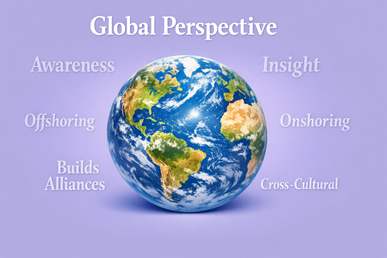
Definition: Global Perspective is the ability to understand worldwide trends, regulatory environments, and cross‑border dynamics while interpreting how global disruptions and opportunities affect local operations. It integrates awareness, insight, and analytical skill to anticipate risks, shape strategy, and navigate global value chains, supply networks, and offshoring/onshoring decisions. It requires strong communication, cross‑cultural understanding, and the capacity to build alliances and collaborative relationships that span countries, cultures, and organizational boundaries. Ultimately, Global Perspective aligns global strategy with organizational goals and delivers impact by strengthening resilience, expanding opportunity, and creating long‑term value in diverse international contexts.
Questionnaires Measuring Goals:
Survey 1 (4-point scale; Competency Comments)
Survey 2 (4-point scale; Competency Comments)
Survey 3 (5-point scale; Competency Comments)
Survey 4 (5-point scale; radio buttons)
Survey 5 (4-point scale; words)
Survey 6 (4-point scale; words)
Survey 7 (5-point scale; competency comments; N/A)
Survey 8 (3-point scale; Agree/Disagree words; N/A)
Survey 9 (3-point scale; Strength/Development; N/A)
Survey 10 (Comment boxes only)
Survey 11 (Single rating per competency)
Survey 12 (Slide-bar scale)
Survey 13 (4-point scale; numbers; floating anchors)
Survey 14 (4-point scale; N/A)
Survey 1 (4-point scale; Competency Comments)
Survey 2 (4-point scale; Competency Comments)
Survey 3 (5-point scale; Competency Comments)
Survey 4 (5-point scale; radio buttons)
Survey 5 (4-point scale; words)
Survey 6 (4-point scale; words)
Survey 7 (5-point scale; competency comments; N/A)
Survey 8 (3-point scale; Agree/Disagree words; N/A)
Survey 9 (3-point scale; Strength/Development; N/A)
Survey 10 (Comment boxes only)
Survey 11 (Single rating per competency)
Survey 12 (Slide-bar scale)
Survey 13 (4-point scale; numbers; floating anchors)
Survey 14 (4-point scale; N/A)

The statements below can be used in your self-assessment (self-feedback) or performance appraisal as examples to demonstrate your "global perspective skills". Having a global perspective means understanding how worldwide trends, cultural dynamics, and economic interdependencies shape decisions and opportunities. It requires interpreting global signals with insight and analytical rigor while communicating clearly across cultures and building alliances that strengthen collaboration and resilience. Ultimately, it turns global complexity into strategic advantage by connecting people, markets, and ideas to create sustainable organizational value.
Awareness
Awareness in the Global Perspective competency is about perceiving, gathering, and understanding global information. It reflects an employee's ability to scan the world, recognize what is happening, and build a foundational mental map of global systems, markets, and cultural contexts. Someone strong in Awareness tracks global issues, monitors geopolitical and regulatory shifts, understands how foreign markets function, and seeks regional perspectives to ensure they see the full picture. The emphasis is on comprehension and observation--being informed, curious, and attuned to global dynamics that may influence the company.
- I understood global systems such as the global economy.
- I analyzed global issues/problems that are having a large impact on the Company.
- Attended training seminars and conferences to increase skills in working with others globally.
- I demonstrated working knowledge of global transactions.
- I monitored geopolitical developments, trade policies, and international regulatory changes to anticipate how global shifts may affect operations, customers, or supply chains.
- I understood the "basics" as to how foreign markets function and operate.
- I sought input from colleagues and partners in different regions to understand how global events or market conditions were perceived locally, ensuring decisions reflected diverse perspectives.
- I understood global and local business environments.
- I was aware of global market trends including shifts in demand, emerging technologies, and demographic changes.
- I understood the commitments & requirements of overseas customers.
Insight
Insight is about interpreting, synthesizing, and acting on that global information to create organizational value. It moves beyond understanding into judgment, foresight, and strategic application. A manager demonstrating Insight uses their global knowledge to anticipate opportunities and risks, assess overseas partners, recognize scalable innovations, and understand the company's competitive position worldwide. Insight is inherently action-oriented and strategic: it turns global awareness into decisions, adaptations, and improvements that strengthen performance across markets.
- I applied knowledge of overseas markets.
- I anticipated opportunities, mitigated risks, and made informed strategic decisions that strengthened global organizational value.
- I identified local innovations that could scale globally.
- I understood the capabilities, maturity, and capacity of foreign affiliates.
- I recognized the company's position in the global marketplace.
- I assessed overseas vendors for capabilities, maturity, technology stack, and cultural fit.
- I implemented changes as a result of having learned from experiences in overseas assignments.
- I anticipated the effects of global disruptions on local operations.
Analytical
Analytical within the Global Perspective competency focuses on an employee's ability to interpret complex global information, evaluate patterns, and make evidence-based assessments. It emphasizes scanning worldwide trends, analyzing regulatory landscapes, assessing competitive forces, and identifying capability gaps or partnership opportunities across borders. This dimension is fundamentally about thinking: evaluating risks, understanding interdependencies, interpreting multilingual data, and tracking performance metrics for overseas operations. Analytical strength shows up when a manager can take vast, diverse global inputs and convert them into structured insights that guide decisions about markets, partners, cost efficiencies, and strategic fit.
- Effectively delivered presentations to international clients.
- Interpreted and analyzed data in several languages.
- I analyzed worldwide trends, regional dynamics, regulatory landscapes, and competitive forces.
- I tracked service quality, productivity, and cost savings for overseas locations.
- I monitored industry trends to spot complementary strengths in other organizations.
- I identified gaps in the company's capabilities that could be filled through partnership.
- I evaluated risk, complexity, and interdependencies before recommending relocation.
- I identified business functions that benefited from cost efficiencies and specialized expertise offered in other countries.
- I scanned the external environment for complementary partners, evaluating strategic fit, and initiating collaborative discussions.
Communication
Communication centers on an employee's ability to connect, convey, and collaborate effectively across cultures, languages, and geographies. It involves listening respectfully, adapting communication styles to cultural norms, facilitating dialogue across time zones, and ensuring clarity in expectations and deliverables. Communication is fundamentally about interaction: enabling understanding among multicultural teams, translating local issues into globally relevant terms, and sharing global insights with domestic colleagues so decisions reflect international realities. Where Analytical is about making sense of the global environment, Communication is about ensuring people across that environment can work together, understand one another, and move in the same direction.
- I am comfortable using teleconferencing equipment to facilitate meetings with others abroad.
- I was excellent communication skills to conducted effective business with individuals from different cultures and/or countries.
- I facilitated open communication with individuals from other countries.
- I listened and understood others and discuss issues in a respectful way.
- I communicated effectively on a multi-lingual basis.
- I encouraged open dialogue among multicultural teams by creating a safe environment where individuals from different countries felt comfortable expressing viewpoints and raising concerns.
- I adapted communication style to align with cultural norms, ensuring messages were understood without misunderstanding or offense across diverse global audiences.
- I clarified expectations, timelines, and deliverables with international partners to prevent ambiguity caused by time-zone differences, language nuances, or cultural assumptions.
- I shared global market insights, regulatory updates, and cultural considerations with domestic teams to ensure decisions were informed by international realities.
- I facilitated cross-border collaboration by translating complex local issues into globally relevant terms that colleagues in other regions could easily understand.
Builds Alliances
Builds Alliances within the Global Perspective competency is about strategic relationship-building across borders. It focuses on forming, nurturing, and aligning partnerships that create mutual value for the organization and its global stakeholders. This dimension emphasizes trust, cultural compatibility, shared goals, and long-term collaboration. A manager strong in Builds Alliances connects global opportunities to strategy, cultivates reliable cross-regional relationships, bridges gaps between dispersed teams, and engages diverse groups to strengthen cooperation. The core idea is people and partnership: identifying the right partners, earning their confidence, and ensuring collaboration flows smoothly across cultures, functions, and geographies.
- I cultivated long-term global relationships with international stakeholders by consistently demonstrating reliability, transparency, and respect for regional business norms.
- I connected global alliance opportunities to broader organizational strategy.
- I aligned global partners around shared goals by clearly communicating mutual benefits, expected outcomes, and global strategic priorities.
- I evaluated potential global partners not only for capability but for cultural compatibility, ethical alignment, and ability to contribute value.
- I built internal support for potential global alliances.
- I identified international alliance structures that maximized mutual value.
- I solicited and engages diverse groups in organizational processes.
- I built strong partnerships with offshore teams to enhance efficiency, access specialized expertise, and support long-term organizational value creation.
- I sought opportunities for strategic alliances.
- I proactively bridged gaps between geographically dispersed teams by facilitating introductions, encouraging knowledge exchange, and removing barriers to cross-regional cooperation.
Global Value/Supply Chains
Global Value/Supply Chains is about designing, managing, and optimizing the operational systems that move products, services, and capabilities across borders. It focuses on how the organization participates in global production networks--sourcing, logistics, distribution, risk mitigation, and cost/value optimization. A manager strong in this dimension anticipates supply-chain disruptions, aligns sourcing with sustainability and regulatory requirements, builds relationships with suppliers and logistics partners, and integrates global production data to improve efficiency and resilience. The core idea is operations and value flow: ensuring that global inputs, processes, and outputs work together to strengthen competitiveness, reduce risk, and create scalable global value.
- I integrated insights from global production, distribution, and market data to optimize cost structures and create value across regions.
- I anticipated global supply-chain risks (such as geopolitical shifts, currency volatility, or regional disruptions) and proactively adjusted sourcing or production plans to maintain continuity.
- I aligned global supply-chain decisions with sustainability, ethical sourcing, and regulatory requirements in each region.
- I collaborated across global value chains (GVCs) to enhance efficiency, quality, and global reach.
- I created efficient and effective global supply chain processes.
- I built strong relationships with international suppliers and logistics partners to improve reliability, reduce lead times, and enhance the organization's global operational resilience.
- I established global product flows for raw materials.
- I leveraged participation in global value chains (GVCs) to access new markets and capabilities.
- I engaged in global value chains (GVCs) to strengthen the organization's competitive position.
- I addressed global supply chain issues.
Offshoring/Onshoring
Offshoring/Onshoring within the Global Perspective competency is about designing, managing, and optimizing where work is performed globally--and ensuring those decisions strengthen long-term organizational value. It focuses on evaluating cost structures, talent pools, operational risks, and strategic alignment to determine which functions belong offshore or onshore. This dimension is operational and structural: coordinating cross-border transitions, establishing governance, integrating offshore teams, mitigating disruptions, and ensuring unified standards and workflows across distributed operations. While cultural understanding helps these transitions succeed, the core of Offshoring/Onshoring is global operating-model design, execution, and continuous refinement.
- I aligned onshore and offshore teams around shared standards, workflows, and performance expectations to create a unified, globally distributed operating model.
- I anticipated and mitigated disruptions during the offshoring transition period.
- I ensured seamless reintegration of processes during onshoring by coordinating knowledge transfer and minimizing service disruption.
- I created shared goals, KPIs, and performance dashboards with offshore affiliates.
- I assessed the alignment of offshoring with long-term strategic goals.
- I established clear governance structures and communication channels to facilitate offshoring.
- I fostered trust, collaboration, and cultural understanding between offshore affiliates.
- I ensured offshore teams felt integrated into the broader organization.
- I coordinated cross-functional and cross-border teams to ensure continuity of service during offshoring.
- I monitored global regulatory, tax, and geopolitical changes to determine necessary adjustments for offshoring/onshoring of business functions.
- I analyzed cost structures, talent availability, operational risks, and long-term organizational capability to determine onshoring/offshoring of business functions.
- I identified opportunities to expand or refine offshoring operations.
Cross-Cultural Understanding
Cross-Cultural Understanding is about how people from different cultures think, communicate, and work--and how an employee adapts to those differences to build trust and collaboration. It emphasizes curiosity, respect, cultural awareness, and the ability to navigate diverse beliefs, behaviors, and work norms. This dimension is interpersonal and relational: creating inclusive environments, appreciating diverse perspectives, adapting behavior to cultural expectations, and helping teams work effectively across borders. While Offshoring/Onshoring may require cultural sensitivity, Cross-Cultural Understanding is fundamentally about human connection and cultural intelligence, not operational restructuring or global workflow design.
- I demonstrated a curiosity about diverse individuals and cultures.
- I created an environment where individual differences are valued and supported.
- I am aware of the culture, behaviors, identities and beliefs of others.
- I understood how cultures differ and how these differences impact work behavior.
- I respected individual differences.
- I understood and appreciate the perspectives offered by others with different cultural backgrounds.
- I worked well with others from different cultural backgrounds.
- I developed both the cultural awareness and business skills to grow our business in all countries, and work effectively across borders with employees, customers, and shareowners.
- I set the example for team on importance of cultural awareness.
- I developed both the cultural awareness and business skills to grow our business in all countries, and work effectively across borders with employees and customers.
Relationships
Relationships within the Global Perspective competency focus on building and sustaining strong, trust-based connections with individuals and organizations across borders. This dimension emphasizes positive interactions, cultural sensitivity, and long-term engagement with customers, suppliers, regulators, and colleagues worldwide. It is fundamentally about depth and continuity: investing time to understand cultural expectations, maintaining ongoing contact, supporting international partners during challenges, and ensuring that global stakeholders feel valued and understood. Relationships are about strengthening the human fabric of global work--trust, rapport, reliability, and mutual benefit.
- I have positive interactions with individuals from different cultures and backgrounds.
- Built working relationships with others across cultures.
- I formed strong client relationships with international partners.
- I considered customers point of view when making decisions.
- I invested time in understanding the cultural expectations, communication styles, and business norms of international partners to strengthen trust and reduce the risk of misunderstandings.
- I maintained strong collaborative relationships with business process outsourcing (BPO) partners.
- I maintained ongoing contact with global stakeholders (suppliers, customers, affiliates, and regulators) to ensure relationships remained strong, responsive, and mutually beneficial over time.
- I ensured all customer's unique needs are met with quality products and services.
- I proactively supported international colleagues by offering resources, guidance, or advocacy when regional challenges arise, reinforcing a sense of partnership and shared success.
- I forged new relationships among foreign suppliers.
Collaborative
Collaborative focuses on how people work together across countries to solve problems, share knowledge, and achieve shared goals. It emphasizes teamwork, coordination, and collective action across cultures and geographies. This dimension is fundamentally about joint effort: facilitating cross-regional problem-solving, connecting colleagues with complementary expertise, building cohesion among dispersed teams, and enabling effective cooperation regardless of cultural differences. Collaboration is about the process of working together, whereas Relationships are about the quality and strength of the connections that make that collaboration possible.
- I worked with others from different cultures and countries.
- I worked with individuals having different backgrounds and cultures.
- I cooperated with others on a global scale.
- I collaborated with others respectfully and effectively with other people regardless of differences in cultural backgrounds.
- I engaged in problem solving with individuals outside of the country.
- I collaborated with teams overseas.
- I identified where collaboration with other organizations could create mutual advantage.
- I facilitated joint problem-solving sessions across countries by ensuring all regions contributed insights, constraints, and cultural perspectives.
- I connected colleagues from different countries who had complementary expertise, enabling cross-regional learning, innovation, and mutual support.
- I built cohesion among geographically dispersed teams by creating shared rituals, communication norms, and collaboration practices that bridged cultural differences.
- I worked with teams from other countries.
Global Legal/Regulatory/Compliance
Global Legal/Regulatory/Compliance within the Global Perspective competency is about understanding and navigating the legal, regulatory, and compliance environments that govern global operations. It focuses on knowing the rules--jurisdictions, trade agreements, sanctions, tariffs, political stability, and local regulatory requirements--and ensuring the organization operates within those boundaries. This dimension is fundamentally about risk, governance, and obligation: assessing legal frameworks in host countries, ensuring compliance with both global standards and local laws, and recognizing how differing regulatory regimes shape business activities. It is rooted in protecting the organization, avoiding legal exposure, and making informed decisions based on the external legal environment.
- I have some understanding of legal systems outside of the us but knows how and when to obtain more specific advice and counsel.
- I understood geopolitical and regulatory factors such as trade agreements, tariffs, sanctions, and political stability.
- I recognized how varying legal and regulatory regimes impacted business activities across regions.
- I understood the legal and regulatory environments across all operating jurisdictions.
- I ensured compliance with global standards and local regulations.
- I assessed legal, regulatory, and compliance requirements in host countries.
- I demonstrated awareness of the legal jurisdictions and compliance obligations that shaped organizational operations.
- I understood the legal jurisdictions and regulatory requirements that governed the organization's operations.
- I maintained a clear grasp of the legal frameworks and regulatory requirements governing the company's global and local operations.
Alignment
Alignment is about ensuring that global decisions, partners, processes, and teams all move in the same strategic direction. It focuses on harmonizing global initiatives with corporate goals, balancing consistency with local adaptation, and translating enterprise strategy into region-specific objectives. This dimension is fundamentally about strategic coherence and organizational unity: clarifying roles and decision rights across borders, reviewing partner fit, adjusting processes as needs evolve, and ensuring vendors and affiliates support long-term business goals. While legal/regulatory knowledge may inform alignment decisions, Alignment is ultimately about strategic fit and coordinated execution, not legal compliance.
- I planned and oversaw knowledge transfer, documentation, and training of international affiliates.
- I ensured vendors can meet both current and future business needs.
- I facilitated alignment across borders by clarifying roles, decision rights, and accountability structures.
- I regularly reviewed global partner performance and strategic fit to maintain alignment as markets, technologies, and organizational needed evolved.
- I balanced global consistency with local adaptation.
- I assessed whether a potential global partner aligned with our long-term business goals.
- I adjusted processes as business needs evolved.
- I translated enterprise-level goals into clear, region-specific objectives to better align international teams.
- I ensured global initiatives, local adaptations, and regional decisions all reinforced the organization's long-term strategic direction across countries.
- I ensured alignment with corporate standards, culture, and performance expectations.
Strategy
Strategy within the Global Perspective competency is about designing and steering the organization's global direction. It focuses on interpreting global trends, defining business models, shaping cross-border operating structures, and making deliberate choices about where and how the company competes internationally. This dimension is fundamentally about intentional, forward-looking design: aligning personal and organizational vision with global strategy, restructuring operations across borders, pursuing strategic alliances, and translating global insights into actionable plans for regions and divisions. Strategy is the blueprint--how the organization positions itself, allocates resources, and builds long-term competitive advantage in a global environment.
- I aligned personal vision with global strategies.
- I translated global trends into local strategies.
- I defined global business models for divisions in the organization.
- I strategically restructured operations across borders to improve efficiency, capability, and competitiveness.
- I opened dialogue with organizations that offered complementary strengths.
- I defined global strategies to meet supply chain challenges.
- I sought opportunities for strategic global alliances.
- I strategically relocated business functions to affiliated enterprises abroad.
- I implemented business process outsourcing (BPO) for strategic purposes.
Impactful
Impactful is about how an individual behaves, executes, and influences outcomes in global contexts. It reflects the ability to operate effectively in foreign markets, make decisions that account for global economic forces, secure resources abroad, and coordinate global activities such as outbound distribution or information-system integration. This dimension is fundamentally about action, adaptability, and personal effectiveness: embracing global assignments, learning from setbacks, challenging assumptions, and making decisions that reflect both macro-level forces and on-the-ground realities. While Strategy defines the direction, Impactful reflects the ability to drive meaningful results within that direction--through behavior, execution, and global operational contribution.
- I volunteered for experiences and assignments abroad.
- I accepted setbacks and challenges in foreign markets as improvement opportunities
- I exemplified the skills of a global worker.
- I coordinated the global outbound distribution of products and services.
- I obtained appropriate resources from foreign markets.
- I took off the blinders of the usual way of doing business and consider that there are other ways which may be better.
- I understood the global economic impact of business decisions.
- I developed information systems to help integrate global business activities.
- I made decisions that considered both macro forces and micro realities.