Survey Questions: Business Acumen
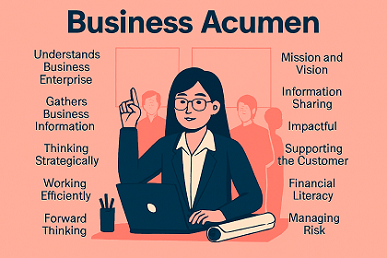
Definition: Business Acumen involves a deep understanding of business enterprises, strategic thinking, and forward-looking approaches to identify opportunities and navigate changing market conditions effectively. It emphasizes the ability to gather and share business information, analyze trends, manage risks, and provide impactful, customer-focused solutions while maintaining financial literacy and regulatory knowledge. Business Acumen also requires efficiency, adaptability, and alignment with the organization's mission and vision, ensuring sound decision-making and meaningful contributions to overall success.
Accountability
Achievement
Action
Attitude
Bias for Action
Results Oriented
Excellence
Flexibility
Change
Resourcefulness
Analytical
Initiative
Juggling Multiple Responsibilities
Career Development
Training
Commitment
Engagement
Pride/Loyalty
Professionalism
Respect for Others
Self-Management
Teamwork
Understands Business Enterprise
Understands Business Enterprise focuses on having a broad, strategic understanding of how a business operates, including financial principles, market dynamics, and stakeholder involvement. This dimension highlights applying business fundamentals, utilizing R&D and market resources, recognizing industry challenges, and ensuring operational alignment with business goals. It prioritizes deep business knowledge and strategic execution, ensuring that decision-makers grasp the overall functioning of an enterprise.
- The members of my team understand the "basics" as to how [company] functions/operates.
- Leaders understand and apply business and financial principles.
- The project manager demonstrates an understanding of the hospital in its entirety and works to achieve results across disciplines, departments, and functions.
- My manager demonstrates an understanding of appropriate R&D, area, and market resources to utilize for specific needs
- My manager demonstrates knowledge of the healthcare market and delivery systems in which we operate
- The project lead understands and uses appropriate R&D and area resources
- Our supervisor applies the knowledge of work processes to influence the achievement of business goals
- The project lead demonstrates sound commercial awareness
- Senior executives understand business fundamentals and practices.
- Senior executives understand the challenge facing [company]
- Coworkers use sound business judgement when making decisions.
- My manager involves key stakeholders (employees, customers, investors, partners) in the planning process to gain diverse perspectives and buy-in.
Gathers Business Information
Gathers Business Information emphasizes actively collecting, analyzing, and utilizing market and organizational data to inform business decisions. This dimension centers on researching trends, gathering customer insights, staying informed on company operations, and integrating external business models to optimize strategy. It prioritizes data-driven learning and continuous awareness, ensuring employees proactively seek relevant information to refine business practices.
- Employees in my department seek clarity when new directions, procedures, or programs are introduced
- My team leader considers business models from outside the organization to help drive the market's success using different approaches
- Coworkers seek to better understand other areas of the company, including their operations, personnel, and output.
- Our team keeps informed of current income and expenses.
- Employees in my department ask the 'right' question to size up or evaluate situations.
- Supervisors gather essential customer data to align our products with their expectations.
- The project leader keeps up to date with business/industry trends using non-company's resources (newspapers, magazines, internet) and shares this information with others
- Associates collect valuable customer insights to ensure our service meet their needs.
- Senior executives conduct thorough market research to understand industry trends, customer needs, and competitive landscapes.
- My manager gathers important information from customers to make sure our products are relevant and useful.
- The project manager keeps up to date with business/industry trends using non-company's resources (newspapers, magazines, internet)
Thinking Strategically
Thinking Strategically focuses on developing structured, long-term business strategies that align with company objectives, market conditions, and stakeholder needs. This dimension highlights forming strategic alliances, implementing business solutions, analyzing business cycles, and ensuring decisions positively impact organizational performance. It prioritizes intentional strategy formulation and execution, ensuring companies make calculated moves that strengthen competitive advantages.
- Senior executives integrate insights from customers, competitors, and internal capabilities to shape strategies that create sustainable value.
- Managers implement long-term strategic solutions to critical problems.
- Managers meet with customers to gain insights into their core need and how to strategically serve them.
- My department develops strategic plans to promote business and organizational strengths.
- Managers create unique strategies that impact the company.
- Our manager formulates business strategies for addressing the company's important needs.
- The team leader anticipates business cycles and trends and makes strategic adjustments in a timely manner.
- Our team connects day-to-day decisions to broader organizational goals.
- The project manager identifies long-term trends, risks, and opportunities in the business environment.
- Employees in my department understand how strategic decisions impact constituents within the company.
- My manager evaluates multiple strategic pathways to strengthen competitive positioning, operational efficiency, or market relevance.
- Coworkers engage in strategic alliances with valued partners.
Working Efficiently
Working Efficiently focuses on maximizing resource utilization, ensuring alignment with business needs, and maintaining a strategic focus on productivity and profitability. This dimension highlights structured processes, smart decision-making, establishing KPIs, and ensuring business strategies lead to measurable success. It prioritizes optimization and effectiveness, ensuring that work is conducted with precision and minimal waste.
- Colleagues weigh alternatives and select practical solutions.
- Our department establishes key performance indicators (KPIs) to measure progress and success.
- My manager links personal goals to [company] growth and productivity goals
- My division takes action based on knowledge of what [company] must do to win the marketplace
- My manager develops and uses resources (people, time, money, supplies, equipment, and space) to improve organizational performance
- Our team focuses on business strategies that will lead to success in the market place.
- Coworkers in my department maintain a focus on the 'bottom line' and profitability.
- My team leader explores new directions/approaches for efficiently accomplishing job objectives
- Leaders are able to align resources to meet the business needs of the company.
Forward Thinking
Forward Thinking emphasizes identifying emerging opportunities, anticipating trends, and proactively adapting to future business challenges. This dimension centers on exploring new directions, considering ESG factors, forecasting industry developments, and viewing obstacles as opportunities for innovation. It prioritizes progressive and proactive adaptation, ensuring organizations stay ahead of evolving markets rather than just responding to them.
- Our department considers impact of actions on other areas of the organization.
- Senior executives recognize early signal of change (economic, regulatory, technological, or social) and translate them into opportunities for innovation, growth, or operational improvement.
- Our team evaluates how emerging technologies, market shifts, and customer expectations could reshape the business.
- Managers communicate the business rationale behind changes, helping employees understand how the transition supports market demands, customer needs, or organizational goals.
- Leaders in my department view problems from a business perspective, opportunity, investment, risks, and anticipated results
- Colleagues identify new business opportunities.
- Leaders develop business plans that are forward looking.
- My coworkers view problems as an opportunity.
- Our manager builds scenarios for possible future business conditions and prepares flexible plans that allow the organization to respond effectively as circumstances evolve.
- Leaders are aware of potential future business opportunities and challenges by keeping up to date with business/industry trends (e.g., 5-year forecast)
- Coworkers in my department consider environmental, social, and governance (ESG) factors to ensure the business is sustainable in the long run.
- My manager identifies capability gaps the organization will face in the coming years and initiates development, hiring, or investment strategies to prepare for those future needs.
Mission and Vision
Mission and Vision focuses on ensuring the organization operates in alignment with its strategic purpose, values, and long-term goals. This dimension highlights understanding business operations, fostering innovation, making decisions that support the company's future direction, and ensuring employees uphold the mission and vision in their work. It prioritizes big-picture strategy and organizational alignment, ensuring teams stay focused on fulfilling the company's overarching objectives.
- The supervisor evaluates whether current strategies, services, and investments support the organization's mission and vision.
- Managers exhibit behavior that is consistent with the vision, mission, and core value of the organization
- Our department translates the organization's mission and vision into clear priorities and decision-making criteria so teams understand how their work contributes to long-term goals.
- Leaders inspire others by communicating a compelling picture of the organization's future and motivating teams to take actions that advance the mission and strengthen the vision.
- Colleagues consider external and internal environmental factors when providing advice and solutions to problems.
- Coworkers in my department have a good understanding of business operations to more effectively align company service to meet the need of its customers.
- My manager identifies emerging trends or shifts in customer needs and uses them to refine the organization's vision, ensuring it remains relevant, competitive, and forward-looking.
- Our team creates robust talent development programs through the identification of key skills gaps and future needs ensuring the company is able to meet its mission and vision.
- My supervisor questions validity of company direction when it does not meet the needs of the area
- My department is adept at recognizing new opportunities and fostering a culture of innovation ensuring the organization stay ahead of industry trends and continue to evolve.
- The members of my team establish clear, long-term objectives that align with the company's vision and mission.
- My division is able to align resources to meet the business needs of [company].
Information Sharing
Information Sharing focuses on facilitating the exchange of knowledge, best practices, and business insights to drive innovation and organizational progress. This dimension highlights effective communication across teams and departments, leveraging company resources, encouraging collaboration, and ensuring employees are informed about industry trends. It prioritizes knowledge accessibility and transparency, making sure valuable information flows efficiently to enhance business operations.
- Colleagues share district ideas/recommendations with the rest of the team to drive market progress
- Colleagues share recommendations and plan with R&D, focusing on adapting to change early within own area.
- Colleagues inform market team of available resources to provide information/developmental contacts for team
- The members of my team share information among other teams and departments.
- Employees at the company encourage team members to share best practices, challenges, and concerns, to drive help innovation and improvement
- Senior executives ensure employees have easy access to relevant information.
- Coworkers in my department assist others in better understanding the company's operations, goals, and strategic challenges.
- Managers use company's communication tools (email, intranet, social media) to share ideas and best practice with others
- Our department facilitates creativity and innovation in individuals by helping them understand different aspects of the business.
- Coworkers share information on best practices to facilitate business workflows and operations during time of transition and change in personnel.
- My team leader shares ideas and methodologies with area VP.
- The project manager encourages area team to keep up with industry changes; makes recommendations regarding recent business publications/resources
Impactful
Impactful emphasizes decisive action, adaptability, and creating meaningful influence in a rapidly changing business environment. This dimension centers on driving change, responding proactively to market opportunities, fostering innovation, and overcoming barriers to success. It prioritizes bold execution and transformation, ensuring individuals and teams create lasting positive effects through their actions.
- Team members recognize constraints and work to remove barriers that may stand in the way of achieving organizational objectives
- My coworkers present a smart and professional image
- Senior executives take prompt action when opportunities arise
- My team incorporates innovative approaches and is adaptable to change.
- My coworkers identify and act promptly to take advantage of potential market opportunities
- Associates act decisively to a frequently changing and uncertain external market.
- Leaders are a "change champion," even when change appears difficult or initially unfavorable
- Leaders coach others to foster an environment which can adapt quickly and willingly to rapid changes
- Our department recognizes "change champions" early when new processes/programs are introduced and points these people out as role models for others to follow
Supporting the Customer
Supporting the Customer emphasizes actively engaging with customers to understand their business needs and provide high-value solutions. This dimension centers on troubleshooting customer issues, anticipating needs, responding effectively to inquiries, and tailoring services to enhance customer satisfaction. It prioritizes customer-centric service and responsiveness, ensuring the business is attuned to meeting its customers' evolving demands.
- My coworkers recognize the individual need of customers.
- Colleagues troubleshoot customer business issues.
- My department responds quickly to customer business inquiries.
- Our team understands the critical business needs of the customer.
- Colleagues anticipate customer's business needs.
- Associates understand the business need of the customer.
- Coworkers provide a high level of business service to customers.
- Employees in my department converse with customers and clients to get a better insight into their business needs.
Financial Literacy
Financial Literacy emphasizes understanding financial principles, business metrics, and economic factors to make informed decisions that impact organizational success. This dimension centers on grasping financial statements, calculating return on investment (ROI), managing assets and liabilities, and interpreting business valuation metrics. It prioritizes financial comprehension and strategic analysis, ensuring employees can integrate financial insights into decision-making.
- Employees possess a clear grasp of the company's financial indicators.
- The project manager is able to correctly assess current/estimated valuations.
- Our team calculates return on investment (ROI) for various business projects.
- The project manager understands the financial metrics used by the department.
- Colleagues understand cash flow procedures and statements.
- My supervisor understands financial terminology, statements.
- Employees in my department know how to use financial information to make an impact on the organization.
- My manager has a good understanding of liabilities and assets.
- Leaders understand the costs, profits, markets, and added value of issues.
- The project lead has an understanding of various asset classes and how to interpret balance sheets.
- Employees in my department understand the financial metrics used by the company.
Managing Risk
Managing Risk focuses on identifying, evaluating, and addressing potential risks to minimize negative impacts and capitalize on opportunities. This dimension highlights assessing business consequences, creating risk management strategies, understanding financial and operational risks, and integrating risk awareness into decision-making. It prioritizes proactive risk assessment and strategic mitigation, ensuring businesses can make informed choices while balancing uncertainty.
- The members of my team review business processes to uncover inefficiencies, vulnerabilities, or compliance gaps.
- Leaders recognize the potential business impact of specific risks.
- Coworkers in my department balance potential upside and downside when evaluating strategic options.
- Coworkers anticipate the consequences to the business of different potential risk events.
- My manager integrates market, financial, and operational data to identify emerging risks that could affect business performance.
- My team evaluates risks in terms of their business impact and likelihood of occurrence.
- Our team rewards risky ideas that may yield significant benefits to the business.
- My manager uses risk management to make more effective business decisions.
- Supervisors in my department prioritize risk based on an understanding of their possible impact to the company.
- Our department analyzes current business practices to make better informed decisions.
- Our team develops contingency plans for high-impact risks ensuring the organization is prepared to respond quickly and effectively when conditions change.
- Leaders create a risk management strategy to meet the business need of the organization.
- My coworkers perceive potential risk to the business.
Analytical
Analytical focuses on interpreting, assessing, and making sense of complex data to generate insights, recognize patterns, and support informed business decisions. This dimension highlights the ability to critically analyze market trends, describe and summarize information, and make decisions based on data rather than intuition. It prioritizes problem-solving and data interpretation, ensuring that employees can transform raw information into meaningful strategic actions.
- Employees in my department foster a critical analysis of events and issues.
- Coworkers in my department can effectively interpret and analyze market data.
- My manager recognizes patterns and trends in the business.
- My manager bases decisions on business data rather than on intuition or hunches.
- Associates are able to recognize trends in underlying data.
- Supervisors are able to describe and summarize data.
- Colleagues are able to decipher complex data making it easier to generate new insights.
- Our manager interprets data to make informed business decisions.
- The supervisor understands complex issues and problems.
- The project manager can effectively interpret and analyze data.
- Coworkers in my department look at business problems from a variety of perspectives.
Managing Change
Managing Change emphasizes guiding and implementing business transitions effectively, ensuring employees and departments adapt smoothly to new workflows and organizational shifts. This dimension centers on driving acceptance of changes, fostering cooperation, reducing resistance, and sponsoring efficiency improvements. It prioritizes adaptation and business continuity, ensuring teams embrace innovation while maintaining stability.
- My team leader evaluates how proposed changes will affect financial performance, customer expectations, operational efficiency, and long-term strategic goals.
- Leaders anticipate market, regulatory, or competitive shifts and proactively adjust business processes, structures, or priorities to keep the organization positioned for success.
- Leaders are able to get department employees to accept new business workflows.
- My manager aligns change initiatives with broader business strategy.
- Coworkers in my department facilitate in the development and implementation of changes to business operations.
- My team sponsors and promotes business efficiency changes.
- Our department monitors the impact of change initiatives on key business metrics and makes timely adjustments to ensure intended financial, operational, or strategic benefits.
- My division works cooperatively with others to implement business changes.
- The project manager facilitates business changes with minimal resistance.
- My manager assists others in understanding business changes.
Market Awareness
Market Awareness focuses on understanding market dynamics, consumer behaviors, competitor strategies, and global trends to position the business effectively. This dimension highlights anticipating opportunities, assessing industry shifts, and staying informed about market forces that impact business success. It prioritizes competitive intelligence and adaptability, ensuring that employees and leaders are attuned to the evolving marketplace.
- My department understands our competitors and their strengths and weaknesses.
- My manager understands consumer behaviors and how they may change in the future.
- My team is able to assess the current market environment.
- Senior executives understand the dynamics of our industry.
- My department anticipates marketplace opportunities and supports speed to market.
- Coworkers in my department understand impacts of domestic & global market events & issues.
Regulatory Knowledge
Regulatory Knowledge emphasizes staying informed about laws, policies, and compliance requirements that govern the industry and business operations. This dimension centers on identifying regulatory risks, aligning strategies with legal standards, and ensuring adherence to industry guidelines. It prioritizes compliance and risk mitigation, making sure businesses operate responsibly while navigating complex regulatory landscapes.
- The project lead creates strategic plans that conform with regulations and industry guidelines.
- Managers are aware of regulations that impact our business.
- My manager maintains currency with laws, regulations, policies, procedures, trends, and developments.
- Leaders are up-to-date with regulatory guidelines and policies.
- Managers identify potential regulatory risk and strategies to mitigate them.