Survey Questions: Accountability
Definition: Accountability is the commitment to uphold responsibility, where individuals and teams reliably fulfill their roles, maintain integrity, and are dependable when needed. It encompasses understanding and accepting personal responsibility for actions, ensuring ownership of processes and outcomes, while fostering collaboration and addressing setbacks, errors, and critical challenges in a proactive manner. Accountability also involves fostering expectations for professionalism, maintaining open communication, and adhering to organizational standards and procedures to drive shared success and performance.
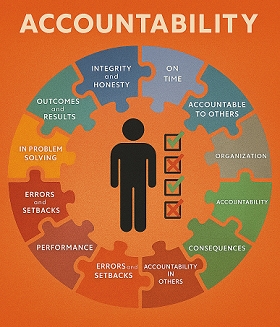
Accountability
Achievement
Action
Attitude
Bias for Action
Results Oriented
Excellence
Flexibility
Change
Resourcefulness
Analytical
Initiative
Juggling Multiple Responsibilities
Career Development
Training
Commitment
Engagement
Pride/Loyalty
Professionalism
Respect for Others
Self-Management
Teamwork
Accountability
Accountability emphasizes taking ownership and responsibility for actions and results. It highlights the proactive aspect of being dependable, fulfilling obligations, and ensuring tasks or projects are completed. This dimension involves willingly accepting responsibility for roles and establishing clear expectations for who is responsible for various aspects of a project or goal. It is about fostering a culture where individuals and teams embrace their responsibilities.
- The supervisor establishes who is responsible for various aspects of the project.
- I am someone who is there when you need them.
- My manager holds employees accountable for meeting performance benchmarks.
- I know how to take responsibility for seeing the project through to completion.
- I feel coworkers willingly accept the obligation to complete tasks.
- My coworkers accept accountability for their actions.
- My manager holds employees accountable for their actions and results.
Consequences
Consequences focuses on acknowledging and addressing the outcomes of actions or decisions. It emphasizes the acceptance of the results, whether positive or negative, that stem from one's actions. This dimension includes understanding the implications of performance, meeting benchmarks, and being held responsible for the impact of decisions. It ensures individuals are accountable not just for their responsibilities but also for any results or repercussions that arise.
- I am fully aware of the consequences for failure to complete this project.
- I willingly accept the consequences for my actions.
- Everyone in our department accepts the consequences for their actions.
- My supervisor demonstrates a commitment to taking responsibility for actions.
- The supervisor holds employees responsible if expectations are not met.
- In our department, employees are willing to answer for their own actions and performance.
- Employees understand that they must accept personal responsibility for their actions.
- The manager expects employees to accept the consequences of their actions.
Process and Procedure
Process and Procedure focuses on the systems and structures involved in achieving accountability. It highlights ownership of implementation processes, submission of action plans and progress reports, transparency in policies, and the development of clear performance goals and measures. This dimension emphasizes the methods and frameworks that guide actions and ensure accountability is systematically integrated into operations.
- The manager develops goals and establishes objective measures of success.
- Our organization projects an image of transparency and trustworthiness in the administration of fair and equitable policies.
- Supervisors in our department document performance goals and include an individual development plan.
- I have a sense of ownership of the process currently being implemented.
- Our team requires team members to present progress reports or prepare contingency plans.
- The supervisor requires employees to submit monthly reports of the work they performed.
- My manager requires employees to submit action plans, timelines or other objectives.
Accountability in Others
Accountability in Others focuses on encouraging and facilitating responsibility in team members. It involves establishing clear roles, rights, and responsibilities, setting challenging but achievable goals, and ensuring employees commit to their tasks. This dimension emphasizes leadership's role in defining expectations, encouraging individuals to take on greater responsibilities, and fostering a culture where accountability is proactively embraced by others.
- Division leadership expects employees to account for their actions and performance.
- Our team leader defines roles, rights, and responsibilities of the team.
- Our department encourages its employees to take on greater responsibilities.
- I recognize the importance of managers encouraging employees to take on greater responsibilities.
- Our department allows employees to set their own performance goals.
- My manager generally seeks commitment from employees prior to assigning tasks.
- My manager encourages employees to set challenging but achievable goals.
- The supervisor understands the importance of holding employees accountable for their work.
- The department manager is effective in defining roles, rights, and responsibilities of employees.
Outcomes and Results
Outcomes and Results emphasizes acceptance and ownership of the final deliverables and consequences. It includes taking responsibility for the results of actions or decisions, ensuring accountability for project outcomes, and requiring employees to accept ownership of their achievements or shortcomings. This dimension is centered on the end goal, emphasizing the importance of accountability for what has been accomplished or delivered.
- Employees in our department accept accountability for results.
- Employees take full responsibility for project outcomes.
- In my department, employees take full responsibility for results.
- Employees here exhibit a sense of ownership of outcomes and results.
- The supervisor requires employees to accept the responsibility for our location's outcomes.
- I always take responsibility for results.
- My manager expects employees to accept accountability for their results.
- I feel that my coworkers take personal responsibility for results.
In Problem Solving
Accountability In Problem Solving emphasizes initiative, ownership, and leadership in addressing challenges. It reflects a proactive stance toward identifying issues, taking responsibility for resolution, and mobilizing others to contribute to solutions. This dimension of accountability is situational and dynamicâoften emerging in moments of disruption, uncertainty, or technical difficulty. It highlights a willingness to confront problems head-on, lead troubleshooting efforts, and ensure that departmental or team-level obstacles are resolved collaboratively. The focus is less on routine output and more on adaptive response, strategic thinking, and the courage to lead through complexity.
- Takes ownership of problems to find the best solutions.
- My manager tackles issues head on and finds solutions.
- The IT department regularly leads the way when helping the team troubleshoot various issues.
- My supervisor takes charge of addressing and solving problems.
- My manager accepts responsibility to lead efforts to solving critical problems.
- Supervisors hold employees accountable for their participation in solving department problems and issues.
- The team leader commits to leading the initiatives to solving critical issues.
Performance
Performance centers on consistent execution, quality standards, and measurable outcomes. It reflects a sustained commitment to doing one's job well, meeting expectations, and being held accountable through formal mechanisms like reviews and goal-setting. This dimension is structured and ongoing, emphasizing personal responsibility, discipline, and reliability in day-to-day work. While problem solving may be episodic and reactive, performance is continuous and proactive--driven by clarity of expectations, ownership of results, and a culture of accountability that spans individual and team contributions. Itâs about showing up, delivering, and improving over time.
- Team members take their jobs seriously and act like an owner when they make decisions.
- I feel my supervisor justly applies disciplinary measures.
- My coworkers accept personal responsibility for producing high quality and timely work.
- I feel performance reviews are effective in determining areas for improvement.
- My manager holds employees accountable through regular performance reviews.
- My manager sets clear performance measures.
- The team leader holds the team accountable to meeting goals.
- I take personal responsibility for the quality of my work.
Errors and Setbacks
Errors and Setbacks emphasizes accepting and addressing mistakes and obstacles. It centers on individuals and teams taking ownership of their errors, learning from setbacks, and actively working to correct issues. This dimension highlights a commitment to continuous improvement, resilience, and accountability for outcomes, even when expectations are not met.
- Coworkers will accept personal responsibility for not meeting expectations.
- I continue to work diligently on a problem despite setbacks.
- Coworkers take responsibility for errors in the production line.
- My colleagues will acknowledge errors and takes the steps necessary to rectify them.
- I take responsibility for errors and actively work to correct them.
- My manager takes full responsibility for lack of results achieved.
- Our department focuses on continuous learning and colleagues will take ownership of mistakes and learn from them.
- My team members will take full responsibility for team's lack of progress.
- The manager requires advanced warning on problems and issues that will affect completion of tasks.
- I recognize when a mistake is made and work to correct the issue.
Organization
- Team members work diligently for the success of the team.
- I feel everyone works hard to ensure the success of the department.
- The team leaders take responsibility for the direction of their team.
- I feel I am personally invested in the success of the organization.
- My director implements and facilitates controls and processes that maintain the integrity of the organization.
- I feel that coworkers fully embrace the responsibilities that contribute to our departmental success.
- My manager takes responsibility for the team's actions and results.
Keeps Supervisor Informed
Keeps Supervisor Informed centers on proactive, upward communication within a hierarchical structure. It reflects an employee's willingness and consistency in updating their supervisor about progress, setbacks, risks, and relevant developments--especially without being prompted. This behavior supports operational transparency, enables timely decision-making, and prevents surprises. It's situational and task-oriented, often triggered by changes in status or the need for guidance. The motivation here is duty-driven: to ensure alignment, accountability, and trust between the employee and their supervisor. While it may involve honesty, its primary emphasis is on communication flow and procedural responsibility.
- Coworkers will make sure the supervisor is always informed of any important events.
- I generally inform the supervisor of progress without having to be asked about it.
- I feel everyone keeps supervisor informed of recent activities.
- I always keep the supervisor informed of relevant information.
- I always keep my supervisor informed of recent events.
- Coworkers willingly inform the supervisor if progress on the task has been delayed.
- I am encouraged to consult with the supervisor before engaging in new procedures that have some risk.
- I am comfortable letting the supervisor know of any setbacks to the progress on achieving goals.
Integrity and Honesty
Integrity and Honesty is a broader ethical construct that applies across all relationships and contexts--not just upward communication. It reflects a person's internal moral compass and commitment to truthfulness, confidentiality, and ethical behavior, even when no one is watching. This includes keeping promises, admitting mistakes, handling sensitive information discreetly, and choosing principle over convenience. Integrity is frequently invisible and self-regulated. It builds long-term trust and credibility, not just with supervisors but with peers, clients, and the organization as a whole.
- People in my department maintain honesty and transparency in all communications.
- My manager keeps their word and does what they say they will do.
- I can be counted on to do what I say I will do.
- My coworkers handle sensitive information with discretion and confidentiality.
- I feel my coworkers uphold ethical standards even when no one is watching.
- People I work with take responsibility for their actions and admit mistakes openly.
- I feel that my coworkers, if presented with a tough dilemma, would choose integrity over convenience.
- My manager is someone you can trust.
Expectations
- My manager follows through on commitments made.
- Colleagues can be counted on to do their role well.
- My manager expects employees to take full responsibility for unmet expectations and make corrective actions immediately.
- Supervisors will hold employees accountable for completing the project successfully.
- The manager sets clear expectations for performance.
- I work to achieve established goals.
- My manager ensures that employee objectives are aligned with the organization's objectives.
- I consistently strive to meet high standards of excellence.
- Our department honors the commitments and promises made to customers/clients.
- My coworkers will consistently follow through on commitments and promises.
On Time
- My coworkers regularly complete tasks on time.
- I always start work on time.
- Colleagues are prepared and on time for meetings and scheduled events.
- Employees in our department holds themselves and others accountable for meeting the deadlines.
- Coworkers will consistently strive to complete work on time or ahead of schedule.
- My coworkers do not make excuses for missed deadlines.
- I always show up for work on time.
- I am able to complete required tasks on time and delivered expected results.
- I do not make excuses for being late for work.
- I accept personal responsibility for the timeliness of work.
Accountable to Others
- The manager is responsible for ensuring that employees are treated fairly.
- Senior leadership exhibits good governance in their role as an executive.
- My manager ensures that employees are compensated fairly and in accordance with established policies.
- I feel our department welcomes the responsibility for meeting the broad range of needs of stakeholders and clients.
- Supervisors in our department are responsible for the fair and just implementation of the contract with the union.
- I consistently exhibit professionalism in interactions with other employees.